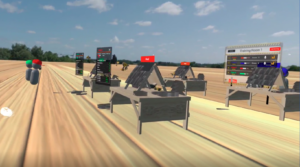
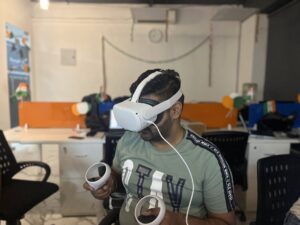
VR safety training is practice for dangerous work, done in a virtual reality headset. A worker puts on the headset, stands in a simulated job site and does the task: clipping in at height, isolating a machine, responding to a fire. If they get it wrong, nobody gets hurt, and the mistake goes on their score.
How does VR safety training work?
A typical session looks like this:
- The trainee puts on a standalone headset such as a Meta Quest 3 or 3S. No PC is needed on site.
- They work through the job with their hands, in the order they would on site, and make the decisions themselves.
- The module checks each step and records the errors.
- A supervisor sees who trained, what went wrong, and who needs a refresher.
With our modules, most sessions finish within 8 to 20 minutes, so a crew can train in a gap in the shift instead of losing a day.
What can you train in VR?
VR suits jobs where a real mistake is dangerous or expensive, and where the real thing is hard to practice on. Our Safety Library covers working at height, confined space entry, lockout/tagout, fire safety for warehouses, and PPE selection and inspection.
The same approach works for learning the job itself, which we call skills training. One example: a US roofing company trained 5,000+ roofers in multiplayer VR with us.
What VR safety training does not replace
VR is practice. It does not replace an in-person evaluation on real equipment where a standard requires one, and it does not make a worker certified by itself. We go through this in detail in Does VR Training Count Toward OSHA Compliance?
It works best alongside classroom and on-the-job training, so people arrive at the hands-on part having already practiced.
How much does VR safety training cost?
Ready-made modules from HapzXR cost $179 to $389 a month for one site, with unlimited trainees. A 90-day pilot starts at $537. A new module built from your own procedures starts from $4,000. You also need headsets. Full pricing is here.
How do you start?
Pick the one job your crews most need to practice, and run it with a small group before you commit to more. If it is not in our library, we can build it from your procedures.