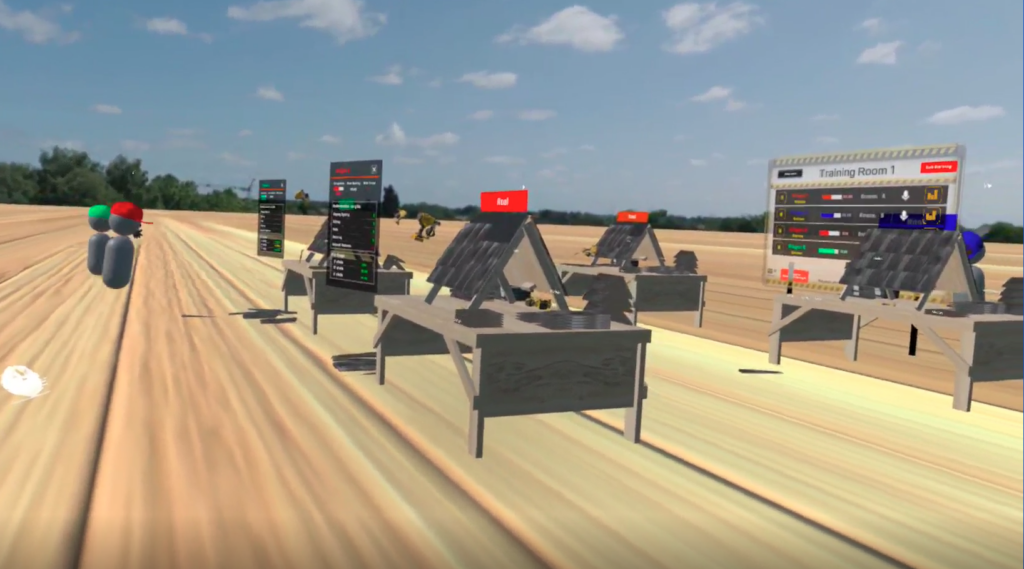
Last month, a roofing trainer in the United States knelt down beside a trainee in India.
They were more than 12,000 kilometres apart. In VR, they were side by side — on the same roof.
The trainer moved from trainee to trainee, checking each one’s work in real time. Your sidelap is too narrow. Watch that nail — you’ve left the head exposed. Trainees from two countries worked the same rooftop together, made mistakes, fixed them, and tried again.
Nobody could fall. Nobody had to fly anywhere.
And here is the part that surprised us most: everyone was smiling. It felt less like a training session and more like a game — while they learned a genuinely dangerous skill.
That session was multiplayer VR training. And we think it is the most underrated shift happening in workforce training today.
The problem with training alone
Most VR training available today is single-player. One worker, one headset, one scripted scenario. They put it on, complete the module, take it off.
It works. It’s certainly safer than learning on a live site. But something important is missing.
Think about how anyone actually learns a hands-on trade. Not from a screen — from a person. An experienced worker stands next to you, watches what your hands do, and corrects you in the moment. You look sideways at how your colleague did it. Someone makes a mistake, everyone laughs, and nobody forgets that mistake again.
Single-player VR removes all of that. It gives you the environment but takes away the people. You get a realistic rooftop and a lonely one.
For safety-critical work, that gap matters. Real jobs are rarely done alone. A confined-space entry has a supervisor and an attendant. A lockout-tagout procedure crosses shifts and roles. A rescue is coordinated, not solo. If the training is solo but the job is a team, you have trained the wrong thing.
What changes when everyone shares the same world
In multiplayer VR training, the trainer and the trainees are in one shared virtual environment at the same time. Everyone sees everyone. Everyone can speak, point, demonstrate, and correct.
Four things change immediately.
A real instructor, in the room. The trainer isn’t a pre-recorded voice. They walk over, watch your hands, and correct you at the exact second you go wrong — the single most valuable moment in any training.
Learning by watching others. Trainees see their colleagues attempt the same task, and they learn as much from the mistakes as from the successes. This is how apprenticeships have always worked.
Real team drills, safely. You can finally rehearse the parts that involve more than one person: the permit check, the handover, the emergency response. Roles, communication and coordination — practised properly, at zero risk.
Distance stops mattering. Your best trainer can teach crews in three countries in one afternoon, without a flight or a hotel. For companies with sites spread across regions, this alone changes the economics of training.
Why it works across every industry
The roofing example is just one. The same model applies wherever the work is hands-on, hazardous, or coordinated:
- Construction: work at height, scaffolding checks, crane signalling between operator and spotter.
- Oil, gas and energy: confined-space entry, permit-to-work, emergency shutdown drills.
- Manufacturing: lockout-tagout across shifts, machine changeovers, line-side safety.
- Mining: evacuation routes, equipment inspection, underground hazard spotting.
- Utilities and telecom: tower climbs, live-line safety, isolation procedures.
- Healthcare and emergency response: triage, coordinated response, high-pressure teamwork.
The common thread is simple. Anywhere the real job requires two or more people to get something right together, training them separately is a compromise. Multiplayer VR removes that compromise.
The part nobody expects: it’s fun
Safety training has a reputation problem. Ask any site worker about their last session and you’ll hear about a slideshow, a video, or a sign-in they had to be chased to complete.
Multiplayer VR breaks that pattern, and it does it honestly — not with gimmicks, but because the format itself is engaging. There are people around you. There’s a bit of friendly competition. There’s the small thrill of standing on a roof and knowing you’re safe. Workers try things they’d never risk in real life, because failure costs nothing.
That enjoyment isn’t a bonus feature. It’s the mechanism. People pay attention to what they enjoy, they repeat what they enjoy, and repetition is what turns instruction into instinct. A worker who has practised the task twenty times because he wanted to will outperform one who watched a video once because he had to.
And it removes the barrier that stops many crews from using digital training at all. There’s no login to remember, no password, no course to click through. A worker who has never used a computer puts on a headset and simply starts doing the job.
The bottom line
Single-player VR proved that we can train people in dangerous environments safely. That was the important first step.
Multiplayer VR is the next one: it brings back the human part of learning that made apprenticeships work in the first place — the trainer at your shoulder, the crew around you, the mistakes you make together — and puts it in a place where mistakes cost nothing.
Proven. Affordable. Life-saving.
Because the goal was never to put a worker in a headset. It was to make sure that on the real site, on the real day, his hands already know what to do.
Want to see it? We can show you a live multiplayer session in about 15 minutes — your team, in one virtual world, from wherever they are. [Book a demo → Contact]