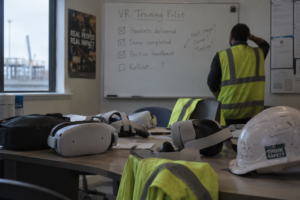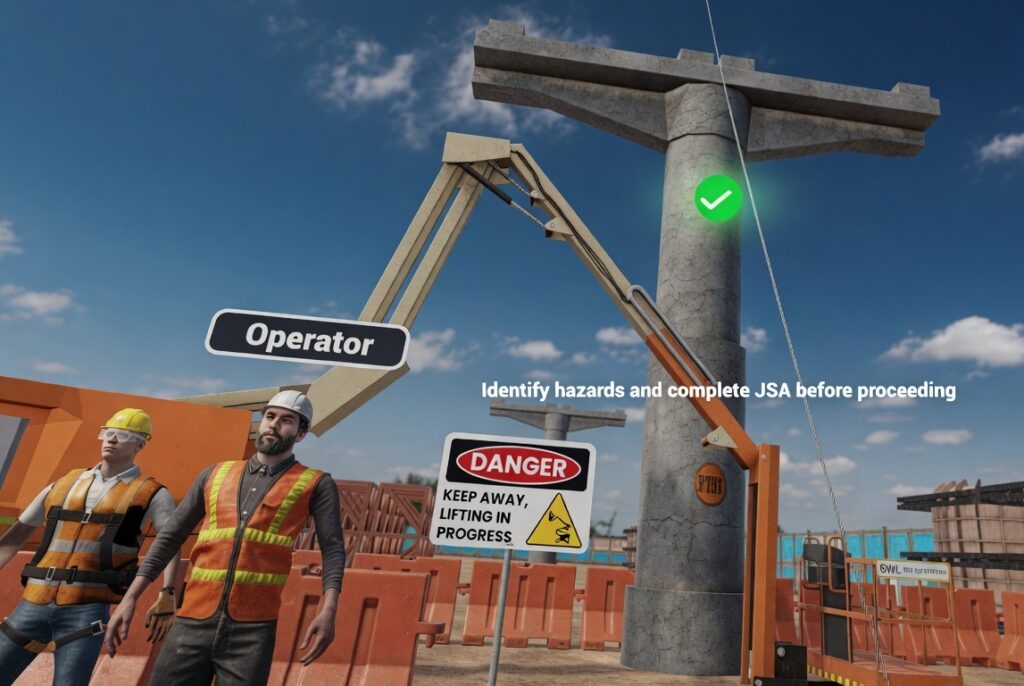
If you manage safety training, you have probably asked this question or heard it from your leadership: “If we move part of our training into VR, are we still compliant?”
It is a fair question. Nobody wants to invest in headsets and simulations only to find out during an audit or an incident investigation that the training does not hold up.
The honest answer is more nuanced than most VR vendors will tell you. VR can satisfy a large part of your OSHA training obligations, and in some areas it is clearly better than what most companies do today. But there are specific requirements where VR does not replace hands-on evaluation, and pretending otherwise puts your company at risk.
In this post we will walk through what OSHA has actually said, where VR fits, where it does not, and how to build a training program that is both effective and defensible.
What OSHA Actually Says About Technology-Based Training
OSHA has never published a standard that mentions virtual reality by name. What OSHA has published, over three decades of interpretation letters, is a consistent position on computer-based and remote training. Three points matter most.
First, OSHA accepts technology-based instruction as part of a training program. Self-paced, interactive computer-based training has been recognized as a valuable component of safety training since the 1990s.
Second, OSHA’s position is that online or computer-based training by itself is not sufficient. In a 2019 interpretation letter, the agency stated that online training alone would not satisfy its training requirements unless the training contains interactive and hands-on components. Training must result in mastery of the material, and workers must have the opportunity to practice skills and have a qualified trainer assess whether they have mastered them.
Third, some standards explicitly require practical evaluation on real equipment, and OSHA has held that line even as technology improves. In a 2025 interpretation letter on powered industrial trucks, OSHA confirmed that remote or live-streamed instruction can cover the knowledge portion of forklift training, but the practical evaluation must be done in person, with a qualified evaluator physically present.
One more point that surprises many people: OSHA does not approve, certify, or endorse any training program or vendor. Not ours, not anyone’s. The employer is always responsible for ensuring workers are properly trained. Any vendor claiming their product is “OSHA certified” is misleading you.
Why VR Is Not the Same as “Online Training”
Here is where the nuance matters. When OSHA writes about the limits of computer-based training, it is describing passive formats: slides, videos, and quizzes. The agency’s core concern is that these formats do not let workers practice skills or let trainers verify mastery.
VR training is built differently. In a well-designed VR simulation, a worker does not watch a video about confined space entry. They perform the atmospheric test, in sequence, with the right instrument. They don the harness, connect the anchor point, and inspect the equipment. They walk through the lockout procedure step by step, and the system records every action, every hesitation, and every mistake.
This directly addresses the two things OSHA says passive training lacks: the opportunity to learn through practice, and the ability to assess whether the worker has mastered the procedure. Modern VR platforms produce a scored, timestamped record of exactly what each trainee did, which is stronger documentation than a signed attendance sheet from a classroom session.
So VR sits in a category of its own. It is not classroom training, and it is not hands-on training on live equipment. It is skills rehearsal in a consequence-free environment, with measurement built in.
Standard by Standard: Where VR Fits
Most OSHA training requirements are performance-based. They tell you what workers must know and be able to do, not what medium you must use. That leaves room for VR, as long as the outcome is genuine competence. Here is how it maps to the standards our clients ask about most.
Fall protection (29 CFR 1926.501 and 1926.503). The construction fall protection standard requires training in recognizing fall hazards and in the procedures to minimize them, including the use of personal fall arrest systems. VR is exceptionally strong here. Workers can experience height, inspect anchor points, and rehearse tie-off decisions repeatedly, something no classroom can offer safely. Pair it with physical harness donning practice and you have a complete program.
Permit-required confined spaces (29 CFR 1910.146). The standard requires entrants, attendants, and supervisors to be trained in their duties and to demonstrate proficiency. VR lets teams rehearse the entire permit process, atmospheric testing, communication protocols, and rescue scenarios that would be dangerous or impractical to stage physically. Note that if your rescue plan involves CPR or first aid, OSHA has stated those physical skills require hands-on practice.
Lockout/tagout (29 CFR 1910.147). Authorized employees must be trained in hazardous energy recognition and isolation procedures. VR simulations of your actual equipment let workers practice the full isolation sequence, including the errors that cause real incidents, without ever exposing them to live energy.
Powered industrial trucks (29 CFR 1910.178). This is the clearest boundary. Forklift training requires formal instruction, practical training, and an evaluation of the operator’s performance in the workplace. VR can deliver the formal instruction and build skills before a trainee ever sits on a real truck, which reduces training time and risk. But the final practical evaluation must happen on real equipment, in person. Any vendor telling you a VR simulator alone certifies forklift operators is wrong.
Emergency action and fire safety (29 CFR 1910.38 and 1910.157). Evacuation routes, alarm response, and extinguisher use are areas where VR shines, because you can put workers inside a realistic emergency, with smoke, noise, and time pressure, and see how they actually respond.
What About HSE and Other Regulators?
For companies operating under the UK’s HSE regime, the logic is similar. Regulations such as the Work at Height Regulations 2005 and the Confined Spaces Regulations 1997 require that workers be competent, meaning they have adequate training, knowledge, and experience. HSE guidance is outcome-focused rather than medium-focused, which means well-designed simulation training that demonstrably builds and measures competence fits naturally into a compliance case. The same principle holds across most international frameworks, including ISO 45001: the burden is on the employer to show workers are competent, and measurable simulation data helps carry that burden.
Building a Defensible Blended Program
Based on what OSHA has actually written, here is the structure that holds up:
- Knowledge and theory. Delivered through VR modules, classroom sessions, or e-learning. VR adds engagement and context that slides cannot.
- Skills rehearsal in VR. Workers practice the full procedure, make mistakes safely, and repeat until the system’s data shows mastery. This is where retention gains come from. In our own deployments, we have measured skill retention improvements above 70 percent compared to traditional methods.
- Hands-on verification. For any task involving physical equipment, a qualified trainer observes the worker performing the task on real or representative equipment and signs off. VR shortens this stage because workers arrive already knowing the procedure, but it does not eliminate it where a standard requires practical evaluation.
- Documentation. Keep the VR analytics reports alongside your training records. When an inspector or an attorney asks how you verified competence, a timestamped performance record answers the question far better than an attendance sheet.
The Bottom Line
VR training is not a loophole around OSHA requirements, and you should be skeptical of anyone selling it that way. It is something better: a way to meet the intent behind those requirements, actual worker competence, more effectively than passive training ever could, while generating the evidence to prove it.
The companies getting this right are not replacing their hands-on programs with VR. They are replacing the weakest part of their training, the passive classroom hours that workers forget within weeks, and arriving at the hands-on stage with workers who already know what to do.
If you are evaluating VR for your safety program and want to see how this works against your specific OSHA or HSE obligations, we are happy to walk you through it with our deployed simulations for working at height, confined space entry, lockout/tagout, forklift operations, and emergency response. Book a discovery call and bring your toughest compliance question.
HapzXR builds VR safety training for construction, manufacturing, oil and gas, and other high-risk industries. This article is for general information and is not legal advice. Always review the specific OSHA standards and interpretation letters that apply to your operations.