Most VR training projects die before they ever begin, and the reason is almost always the same.
Someone in safety or L&D gets interested. They search for what it costs. They find figures like $150,000 and $300,000. They quietly close the tab and decide it is a next-year problem. Next year, the same thing happens.
Here is what those articles rarely tell you: you do not need a six-figure budget to start. A useful, real, custom-built VR training module can be built for a few thousand dollars. The big numbers are real too, but they describe finished multi-module programs, not first steps.
This post is about what your budget actually buys, at every level, so you can start where you are.
Why the Numbers You Read Online Are So High
Two reasons, and neither of them is a law of physics.
The first is where the work is done. Most published pricing comes from studios in North America and Western Europe, where blended development rates run $150 to $250 an hour. The same scope built by a capable team elsewhere costs a fraction of that. This is not a quality argument, it is a labour market. Plenty of enterprise-grade VR training is built outside those two regions, including a good deal of what large Western vendors quietly subcontract.
The second is that those figures describe programs, not modules. When you read “$200,000,” you are usually looking at six scenarios, a custom analytics dashboard, LMS integration, device management, and a fleet rollout. That is a mature program. Nobody starts there, and you should not either.
The Budget Ladder
Here is roughly what different budgets buy in practice.
Around $5,000 to $15,000 — A Real First Module
This is the level almost nobody talks about, and it is where most of our clients start.
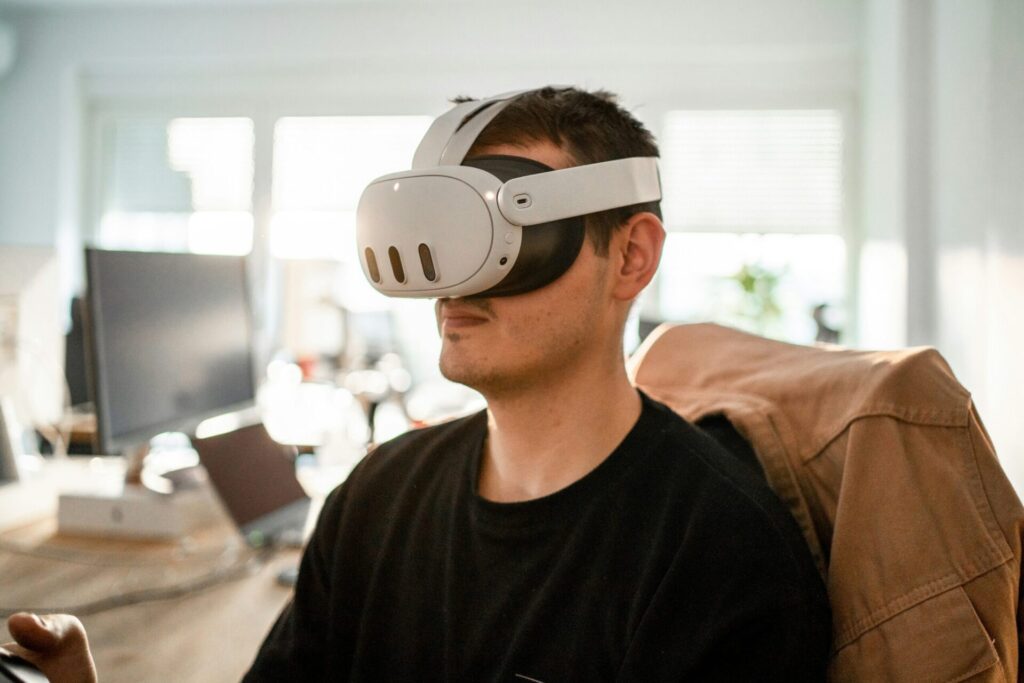
At this budget you get a single, focused training scenario. One procedure, one environment, single-player, built for a standalone headset like the Quest 3. The trainee does the task, the system checks whether they did it correctly, and they get a score at the end.
To hit this budget, scope has to be disciplined. The environment leans on library and modified assets rather than a scratch-built replica of your site. The interactions cover the procedure that matters rather than simulating every object in the room. There is no LMS integration, no multiplayer, no custom dashboard.
What it is not is a demo. It is a working module your people can train on.
For a lot of organisations this is the entire decision. Spend a modest amount, put it in front of twenty workers, and find out whether VR training earns a place in your program before you commit real money. It is a far better use of $10,000 than another consultant’s feasibility study.
Around $15,000 to $40,000 — A Proper Module, Built Around You
At this level the training starts to look like your actual workplace.
Your site, your equipment, your product, modelled properly. More interaction depth, so the trainee can make realistic mistakes and see realistic consequences. Multiple linked steps or branching decisions. Scoring detailed enough to tell a supervisor what someone got wrong, not just whether they passed. Often two or three related scenarios sharing one environment.
This is the range where most single high-value procedures land: a confined space entry, a lockout/tagout sequence, a specific installation task, a machine changeover.
Around $40,000 to $100,000 — A Training Program
Now you are building a set rather than a module. Several scenarios across one or more environments, LMS integration so completions flow into your existing records, an instructor dashboard with per-trainee analytics, and often multiplayer, where one instructor runs a session for a group at once.
This is also where multi-device support, localisation into additional languages, and AI-driven elements typically enter.
$100,000 and Above — Enterprise Scale
Large environments, many scenarios, digital twin accuracy, complex physics, deep systems integration, and rollout across sites and thousands of trainees. Real, but it is a destination, not a starting line. Almost every program at this level got here by expanding something that started small and worked.
What Actually Moves the Number
If you want to influence your own quote, these are the levers that matter most:
- How many distinct scenarios. Five procedures in one environment cost far less than five procedures in five environments, because the environment is reused. Module two is always cheaper than module one.
- Whether you supply models. CAD files, BIM models, or product drawings cut straight into the largest cost line, which is 3D art. If we have to build your facility from photographs, you pay for that. If you hand over the BIM, you do not.
- Single-player or multiplayer. Networked sessions with an instructor and a group are genuinely valuable, but it is an architectural decision, not a toggle. Budget it as a real step up.
- Fidelity. Ask, element by element, whether more realism actually changes the learning outcome. Very often it does not, and that is money saved.
- Integrations. Standalone is simplest. LMS reporting, single sign-on, and custom dashboards each add scope. These can be phased in later.
Plan for These Too
Not to scare you off, but so that nothing surprises you in month six:
Headsets. Far cheaper than people assume. A standalone enterprise headset runs a few hundred dollars, and you do not need a fleet to start. Two or three units are enough to run a pilot with dozens of workers on a rotation. Buy the fleet after the pilot proves out, not before.
Content updates. Your procedures and equipment change. Budget something each year to keep the module accurate, or it slowly becomes wrong and people stop trusting it. On a small module this is a small number.
Someone to own it. The most common cause of a failed VR program is not cost or technology. It is that nobody was responsible for scheduling sessions, charging headsets, and reviewing the data. That role does not need to be full time, but it needs a name attached.
The Case for Starting Small
The strongest argument for a small first project is not that it saves money. It is that it makes the second project much better.
Once a module is in front of real workers you learn things no scoping document can tell you. Which parts confuse people. Which interaction the trainer actually wants. What the data needs to show for a safety manager to act on it. Whether workers engage with it at all.
Teams that start with one tight scenario and expand consistently end up with better programs than teams that spend a year designing a comprehensive suite up front. The environment you build in project one gets reused. The lessons carry forward. And you are making the big budget decision with evidence instead of a brochure.
Questions Worth Asking Any Vendor
- What exactly is in the quote, and what is not?
- What would module two cost in the same environment?
- How much of the environment is custom-modelled versus library assets?
- Can we start with one scenario and expand, or does this need to be committed up front?
- Who owns the source project files and 3D assets when the project ends?
That last one catches more buyers out than any other. Get the answer in writing.
The Short Version
VR training is not a six-figure commitment unless you choose to make it one. The entry point is a genuine, working, custom module for a few thousand dollars, and every sensible program grows from something like that.
The real risk is not overspending. It is spending another year deciding.
Tell us the procedure you want to train, roughly how many people, and the budget you have to work with — including a small one. We will tell you honestly what is achievable at that level, and if the honest answer is that your budget does not fit the scope yet, we will tell you that too.
HapzXR builds production-ready custom VR training for construction, manufacturing, oil and gas, healthcare, and other high-risk industries. Ranges above reflect typical project scopes and are for orientation, not a quotation.