Use both. The classroom is the better place to explain rules and answer questions. VR is the better place to practice the job, because the worker does the task and can fail safely. Neither one replaces an in-person evaluation on real equipment where a standard requires it.
VR and classroom training compared
| Classroom | VR | |
|---|---|---|
| Explaining rules and the reasons behind them | Strong: a trainer can adapt and take questions | Limited: better kept short |
| Practicing the task | Limited: mostly slides, video and discussion | Strong: the trainee does each step |
| Making a dangerous mistake | Can only be described | Can happen safely, and be scored |
| Same training every time | Depends on the trainer and the day | Same scenario for every trainee |
| Record of what happened | Usually attendance and a quiz | Each attempt, with the errors |
| Equipment needed | A room and a trainer | Headsets, and someone to run the session |
| Hands-on evaluation on real equipment | Not replaced | Not replaced |
When is classroom training the better choice?
When people need to understand something: a new regulation, why a procedure changed, what went wrong in an incident. A good trainer reads the room, and a discussion often brings up problems no module would.
When is VR the better choice?
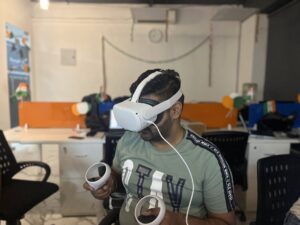
When people need to do something and the real thing is too dangerous, too expensive or too disruptive to practice. Working at height, confined space entry and lockout/tagout are good examples. Trainees can repeat a scenario until they get it right, and supervisors can see who still needs help.
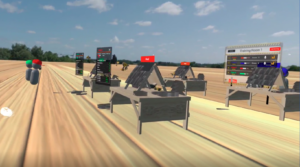
Group training does not have to stop at the classroom either. In our roofing program, a trainer in the USA and up to 10 trainees in India worked on the same virtual roof, talking over voice chat.
How do you use them together?
- Classroom first: cover the rules and the reasons.
- VR next: practice the job until the errors stop. With our modules, most sessions finish within 8 to 20 minutes.
- Real equipment last: do the supervised, hands-on evaluation. Here is what OSHA has said about it.
What does it take to try VR?
Less than most people expect. New to the idea? Start with What Is VR Safety Training? Our Safety Library runs on Meta Quest 3 or 3S, plans start from $179 a month with unlimited trainees, and a 90-day pilot starts at $537.