A worker fell from a rooftop.
He survived. A fractured leg, weeks off work, a family that got a phone call nobody wants to receive. By the standards of falls from height, he was lucky. Falls remain one of the leading causes of death in construction worldwide.
Here is the part that should trouble every safety professional reading this:
He had completed his safety training.
He had signed the register. He had watched the videos. He had answered the questions correctly. On paper, in the file, in the audit — that worker was trained.
He was new. He was still learning. And the place where he was still learning was forty feet in the air.
Trained on paper, untrained in the hands
There is a gap in workforce safety that we don’t talk about honestly enough. It is the gap between knowing something and being able to do it.
A worker can tell you, correctly, that he must maintain three points of contact. He can recite the harness inspection steps in order. He can pass the test with full marks.
Then he stands on a live edge for the first time, with wind, with noise, with a supervisor waiting, with his own heart going — and his hands have never done this before. Not once.
Everything he learned was in his head. Nothing was in his body.
This is why “he had been trained” and “he was ready” are not the same sentence. Our training records measure the first one. Incidents measure the second.
Why the traditional methods leave the gap open
None of the standard approaches are wrong. Each of them is simply incomplete on its own.
Classroom and toolbox talks transfer knowledge well. They cannot build physical skill. You cannot learn to move on a roof while sitting in a chair.
Videos and e-learning scale beautifully and cost little. But watching someone else perform a task creates a dangerous illusion — it feels like competence. The learner walks away confident and unpractised, which is the worst possible combination on a live site.
On-the-job training is the only method that builds real skill, and it is the reason the gap persists. Because on-the-job means the first repetition happens on the job. The learning curve and the danger curve are the same curve. Mistakes are how humans learn, and here a mistake costs a leg, or a life.
So we are left with a genuine problem: the only method that truly builds skill is the one where errors are unaffordable.
What would have changed his day
Now imagine a different version of that worker’s first day.
Before he ever touched a real roof, he had already been on one — fifty times.
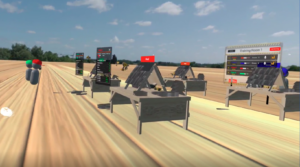
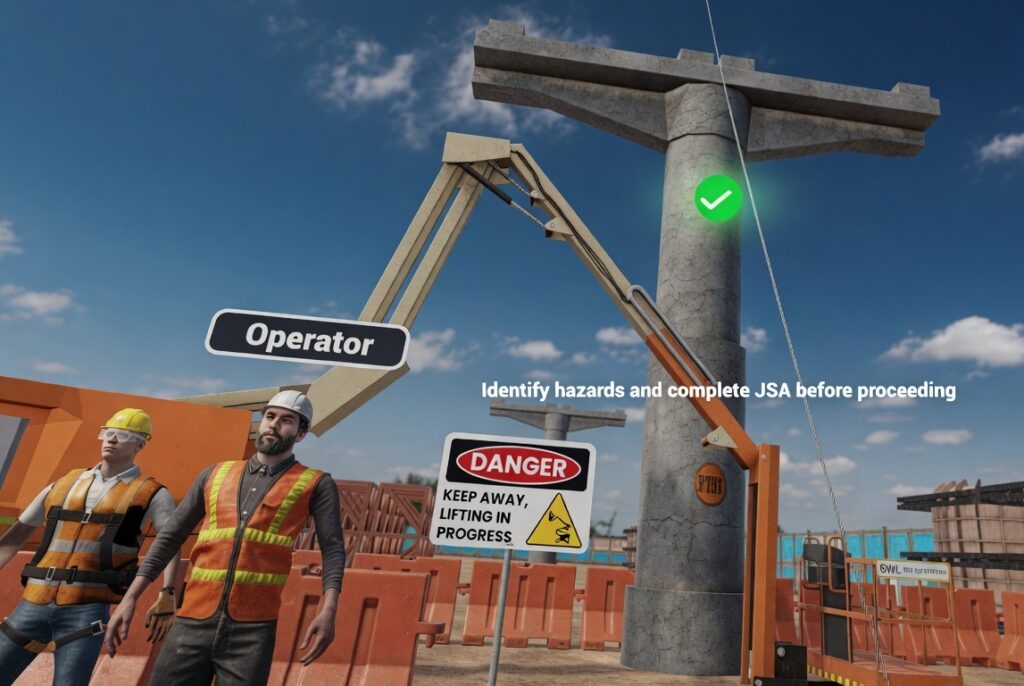
He put on a headset and stood at the edge. The first time, he froze; everybody does. He clipped the harness wrong and the system stopped him. He tried again. He learned the correct sidelap, saw exactly what an exposed nail head looks like, and understood why it matters. He walked the surface until his feet stopped hesitating. He made every beginner’s mistake — the wrong anchor point, the rushed step, the moment of forgetting to check — and each mistake cost him nothing but another attempt.
By the time he stood on the real roof, his body had done it fifty times. The edge was not a surprise. The harness was routine. His hands knew the job before the job mattered.
That is not a new idea. It is exactly how we have trained pilots for decades. No airline puts a trainee in a cockpit with passengers because he passed a written exam. He fails, repeatedly, in a simulator first — engine failures, bad weather, emergencies — until the response is instinct rather than recall.
We accepted long ago that pilots deserve that. Construction workers, roofers, confined-space entrants and line workers deserve it too.
The point is repetition, not technology
It would be easy to read this as an argument for VR. It isn’t, quite. It is an argument for safe repetition, and VR simply happens to be the first tool that makes safe repetition affordable at scale.
That distinction matters when you evaluate any training program, ours included. The question to ask is not “is it immersive” or “is it modern.” The question is simpler and harder:
How many times will this worker perform the actual task before the day it can hurt him?
If the answer is zero, the training may satisfy the auditor, but it has not prepared the worker. And the gap stays open.
What we owe the next new worker
The worker who fell will heal. Many don’t.
What stays with me is that nothing in that story was unusual. A new worker. Some instructions. A few videos. A signature on a register. Then straight up to height, learning the real job in the one place where learning is punished.
We have the means to change the order of those events — to move the failures, the fumbles and the first attempts into a place where they cost nothing, and send workers to the real site already carrying the practice in their hands.
Because the goal was never a completed training record.
It was to make sure that on the real site, on the real day, his hands already know what to do.
See how it works. We can show your team a live VR training session in about 15 minutes. Book a Demo