A senior design engineer once described the problem to us like this: “I have looked at this station model for eight months. I can tell you the coordinate of every column. But I have never once stood in it.”
That gap, between knowing a model and experiencing a space, is where a surprising number of expensive problems hide.
Metro, rail, and highway design teams already work in extraordinarily detailed federated models. Civil, structural, MEP, systems, architecture, all coordinated, all clash-checked. The models are not the problem. The problem is that a model reviewed on a monitor is reviewed from outside, in plan and section, at a scale no human ever occupies.
Some issues only reveal themselves at eye level, at 1:1, from where a passenger or a technician will actually stand.
What Reviewing on a Screen Cannot Show You
Automated clash detection is very good at what it does. It will find the duct passing through the beam. It will not tell you any of the following:
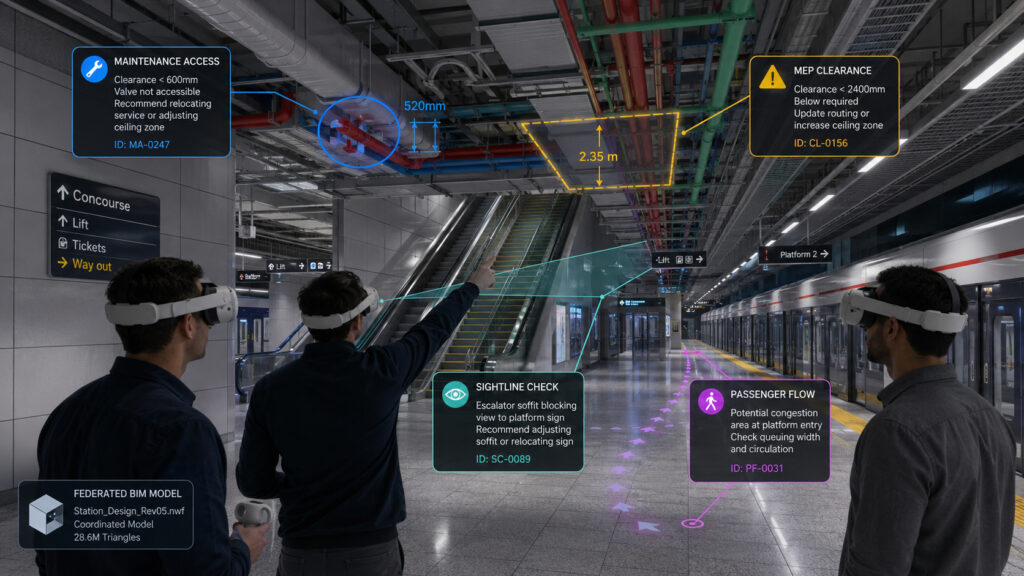
Sightlines. Can a passenger standing at the concourse entrance see the platform wayfinding sign, or does the escalator soffit cut it off? Can the station controller see the full platform edge from the operations room?
Perceived space. A concourse that reads as generous in plan can feel oppressive at 2.4 metres of clear height under a services zone. There is no clash. There is only a station that feels wrong once it is built.
Maintenance access. A valve, a filter, an isolation switch: technically accessible, geometrically clash-free, and genuinely unreachable by a person wearing gloves holding a tool. This is the single most common category of issue teams report finding in immersive review.
Evacuation and passenger flow. Egress routes are analysed and modelled, but walking one, at speed, with the actual sightlines and signage placement, surfaces hesitation points that no calculation flags.
Interface and constructability. Where two disciplines meet and both are individually compliant, standing at the junction often makes the sequencing problem obvious in seconds.
None of these are failures of the design team. They are failures of the review medium.
The Economics Everyone in Infrastructure Already Knows
The cost of changing a design rises steeply the later it is discovered. Changing a line on a drawing during detailed design is close to free. Changing it during construction means a variation order, programme impact, and often a claim. Discovering it after handover means rework in a live asset.
This is the entire justification for BIM coordination, and it is well accepted. Immersive review is simply an extension of the same logic: it moves a further category of issue, the experiential ones, into the phase where fixing them is cheap.
The value is not “VR is impressive.” The value is that a two-hour immersive review session in detailed design can surface issues that would otherwise be found by a site engineer eighteen months later with concrete already poured.
What an Immersive Design Review Actually Looks Like
The practical version is less dramatic than the marketing version.
You take your federated model, typically Revit or Navisworks, run it through an optimisation pipeline so it performs at a stable framerate, and load it onto standalone headsets. No workstation, no cables, no dedicated VR room.
A review session then works much like any design review, except participants are inside the model. Typically:
- Multiple participants join the same session from different offices, each represented in the space, each able to point at what they are talking about.
- Participants can walk at 1:1 scale, or switch to a scaled overview of the whole station box.
- Layers toggle by discipline, so structure can be hidden to inspect services routing.
- Issues are marked in place with a comment, and exported back to the coordination workflow as BCF so they land in the same issue tracker the team already uses.
That last point matters more than anything else on the list. A review that produces findings nobody can action is theatre. The output has to flow back into the process the team already runs.
Where It Fits in the Programme
Immersive review is not a single event. The teams getting real value use it at three distinct points:
Concept and scheme design. Testing spatial intent, passenger experience, and massing before the design is expensive to change. Also useful internally for aligning a multidisciplinary team on what is actually being proposed.
Detailed design coordination. The highest-yield stage. Maintenance access, plant room layouts, service routing, interface zones. This is where the maintainability issues get caught.
Pre-construction and method review. Walking a construction sequence, checking temporary works clearances, and briefing site teams on complex or confined sections before mobilisation.
A fourth use, increasingly common on metro programmes, is operational readiness: giving station staff and the operator’s team a walkthrough of a station months before handover, so training and procedures are ready on day one rather than developed reactively.
The Honest Objections
Anyone who has been through a false start with technology on an infrastructure programme is right to be sceptical. The common objections are fair.
“Our models are too heavy.” Most federated infrastructure models will not run in VR untouched. They need optimisation: decimation, instancing, texture handling, and often a stripped review-specific export. This is real work, and it is the main technical cost of doing this properly. Any vendor who tells you your Navisworks file just opens in a headset has not worked at your scale.
“The model changes weekly.” True, and it means the pipeline has to be repeatable rather than a one-off conversion. Ask specifically how a vendor handles model updates and how long a refresh takes. If the answer is measured in weeks, it will not survive contact with a live programme.
“We already do clash detection.” You should keep doing it. Immersive review does not replace automated clash detection; it catches a different class of issue that automation is structurally unable to detect, because those issues are about human experience rather than geometry intersection.
“Motion sickness and headset logistics.” Legitimate, and mostly solved by teleport-based movement rather than smooth locomotion, short focused sessions, and treating headsets as shared meeting-room equipment rather than personal devices.
Starting Small Is the Right Move
The sensible entry point is not a programme-wide rollout. It is one station, one design stage, one review session, run alongside your existing coordination process so you can compare what each finds.
That is a small, contained piece of work. If the session surfaces two maintenance access issues that would otherwise have appeared on site, the exercise has more than paid for itself, and you will know whether it deserves a place in your standard design assurance process.
If it does not find anything, you have learned that cheaply too.
The Point
Design teams on metro, rail, and highway programmes are not short of model data. They are short of ways to experience it before it is built.
Immersive review is a straightforward extension of the coordination work these teams already do well, aimed at the specific category of problems that only become visible when you are standing inside the design at full scale.
If you are running design or PMC on an infrastructure programme and want to test this on a live model, tell us the stage you are at and the software your models sit in. We will walk you through what an optimisation pipeline for your model would involve and what a first review session would realistically catch.
HapzXR builds immersive design review, digital twin, and XR visualization tools for infrastructure, construction, and industrial programmes. We work from your existing BIM and CAD data.