Marcus had been on roofs for exactly four days when he ruined his first bundle of tiles.
It was not really his fault. His trainer, a foreman named Dale with twenty years of experience, was on the other side of the roof helping two other new hires. Marcus was left to figure out the cut on a hip tile by himself. He measured wrong, cut wrong, and by the time Dale walked over, three tiles were scrap and the sidelap on Marcus’s last course was a quarter inch short.
“That row comes off,” Dale said. “All of it.”
This is how most roofers learn. On a real roof, on a real job, on a customer’s home, with real material costs and a real schedule ticking. One experienced trainer, a handful of new installers spread across a slope, and every mistake either caught late or shipped to the customer as a future leak.
Now imagine training Marcus a different way.
A Roof That Forgives Mistakes
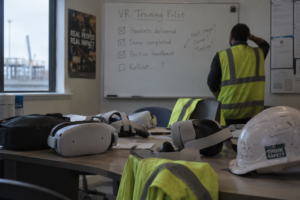
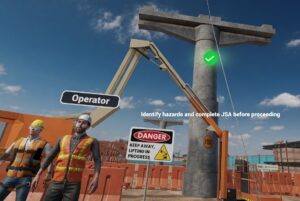
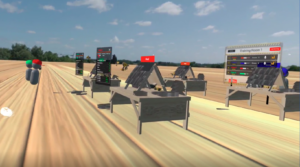
It is 7:30 in the morning at a training center. Ten new installers put on VR headsets. When the world loads, they are all standing on the same roof. Not a cartoon roof. A properly modeled roof deck with underlayment, battens, chalk lines, and pallets of tiles that look and behave like the real product they will install next month.
Dale is there too. But in this roof, Dale can be everywhere at once.
He stands at the ridge and watches all ten trainees at the same time. He sees Marcus reaching for a tile. He sees Priya setting her first course. He sees two guys in the back racing each other, because of course they are.
“Everyone stop and look at me,” Dale says into his mic. Ten heads turn. He picks up a tile, and every trainee sees exactly what he sees. “This is your exposure line. If your tile sits below this line, water gets in. Watch my hands.”
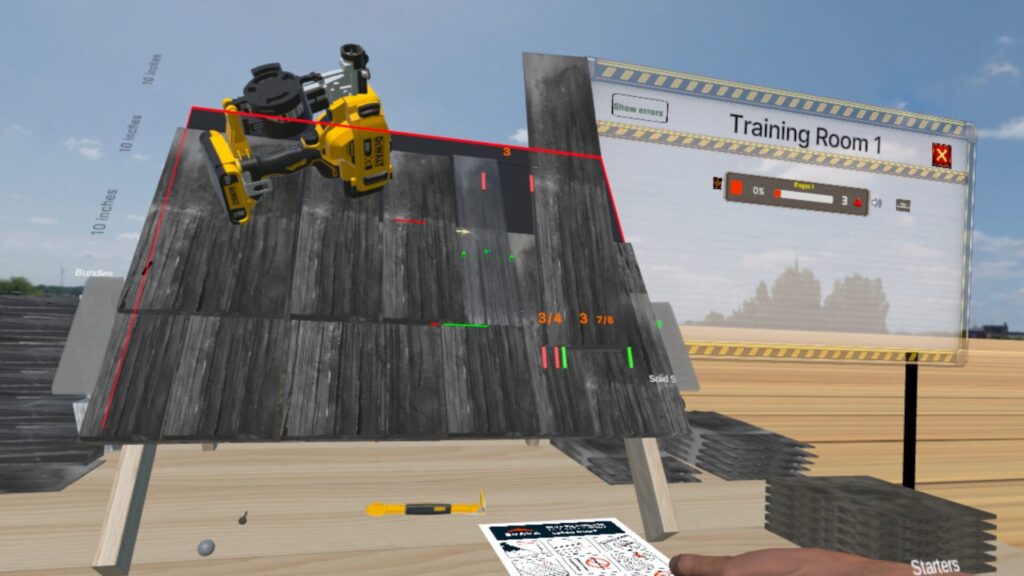
He places the tile. The gap is right. The sidelap overlaps correctly. A soft green highlight confirms it. Then he deliberately places the next one wrong, short on the sidelap, and the tile glows red with a note floating above it: Sidelap insufficient. Water path exposed.
“That red tile,” Dale says, “is a callback in two years. Now you try.”
Ten trainees start laying tiles. This is the part that no classroom, no video, and no single roof in the real world can do: every trainee is installing at the same time, and the system is checking every single placement. Gap spacing. Sidelap overlap. Exposure. Nail position. Nothing gets past it, even when Dale is looking the other way.
When Marcus lays a tile with the exposure slightly off, he does not have to wait for a foreman to walk over and notice it three courses later. The roof tells him instantly. He pulls the tile, resets it, and gets the green. The lesson lands in three seconds instead of three days.
When and How to Cut
Cutting is where new installers waste the most material and lose the most confidence. So Dale runs the cutting module next.
A hip section appears on everyone’s roof. Trainees have to decide where the cut line falls, mark it, and make the cut. In the real world, this exercise costs a tile per attempt. In VR, Marcus cuts wrong, sees exactly why the piece does not fit, and tries again. He does it eleven times in twenty minutes. On a job site, eleven practice cuts is eleven ruined tiles and a very unhappy foreman.
By the ninth attempt, something clicks. He stops measuring from the wrong reference edge. Attempts ten and eleven are clean.
Nobody swept up a single shard.
The Part That Happens After Class
Here is what makes this approach really work, and it is not the multiplayer session. It is what happens after.
The same application has a single-player mode. Marcus takes a headset home for the week, or uses one in the break room, and runs the full installation sequence alone. First course, field tiles, cuts, hips, ridge. The system scores every run: placement accuracy, sidelap consistency, exposure control, time.
He runs it ten times before his first real job.
Think about what that means. The first time Marcus steps onto an actual customer’s roof, it is not his first roof. It is his eleventh. His hands already know the sequence. His eyes already know what a correct sidelap looks like. Dale is not teaching him from zero on a live job; he is verifying skills Marcus already built.
And Dale does not have to guess who is ready. He opens the dashboard and sees every trainee’s runs, scores, and problem areas. Marcus struggles with valley cuts? The data shows it before it ever shows up on a customer’s home. Priya scored clean on every module? She is ready for the crew.
Why This Matters Beyond Saved Tiles
Wasted material is the visible cost, but it is the small one. The bigger ones are the ones roofing companies feel every year:
Callbacks from installation errors that surface as leaks months later. Slow ramp-up, where a new hire takes a full season to become productive. Instructor time, where your best foreman spends his days repeating the same basics one trainee at a time. And risk, because every hour a beginner spends fumbling on a real roof is an hour of fall exposure that did not need to happen.
A virtual roofing classroom attacks all four at once. One instructor trains ten or more people simultaneously instead of two or three. Mistakes are corrected instantly and cost nothing. Trainees arrive at their first job with repetitions already behind them. And the riskiest phase of learning, the clumsy first attempts, happens at zero feet of elevation instead of twenty.
Built Around a Real Product, Not a Generic Roof
One detail matters more than people expect: the training is built around the company’s actual tile. The dimensions, the interlock, the correct gap, the manufacturer’s specified exposure. Trainees are not learning “roofing in general.” They are learning to install the exact product they will hold in their hands, to the exact standard the manufacturer warranties.
That is also why this works for manufacturers, not just contractors. A tile manufacturer that trains its installer network in VR is protecting its own warranty claims and its own brand, because every badly installed roof carries the manufacturer’s name on it, no matter whose crew made the mistake.
The First Roof Should Never Be the Real One
Marcus finishes his first real installation a few weeks later. No scrapped bundles. Sidelaps consistent from eave to ridge. Dale checks the exposure on a few random courses and finds nothing to correct.
“You sure this is your first roof?” Dale asks.
It is not, of course. It is his eleventh. The first ten just happened to be virtual.
That is the whole idea. Practice where mistakes are free. Perform where they are not.
We built exactly this kind of multiplayer and single-player VR installation trainer for a roofing tile manufacturer, with live instructor sessions, real-time placement checking for gap, sidelap, and exposure, cutting practice, and per-trainee analytics. If you train roofing installers, whether you are a contractor building crews or a manufacturer supporting your installer network, we would be glad to show you how it works. Book a discovery call and see the virtual roof for yourself.
HapzXR builds VR training for roofing, construction, and other high-risk trades. Our simulations are custom-built in Unity around your products, your procedures, and your standards.