Yes. VR training can improve safety knowledge and help people remember what they have learned. It also gives workers a way to practise recognising hazards and making decisions in simulated situations.
However, a successful VR session does not automatically prove that someone can perform a task safely at work. That requires assessment beyond the headset.
For construction companies, manufacturers and chemical plants, the useful question is: what should workers learn in VR, and how will we check that the learning carries over to the job?
Here is what the evidence supports, how the training can work and what a company should measure before expanding its investment.
What does the research say?
A systematic review published in Safety Science in 2024 examined 52 articles covering VR safety training across several sectors. Its meta-analyses found that VR outperformed traditional training methods in knowledge acquisition and retention. The authors also highlighted the need for more long-term retention measurements. Read the research.
That is encouraging evidence for learning. Claims about workplace behaviour and accident reduction need a separate level of proof.
A 2023 review of 136 safety-relevant VR training studies found that evaluation concentrated mainly on learning and participants’ reactions. Far fewer studies examined changes in workplace behaviour or operational results. Read the review.
The practical conclusion is straightforward: there is a credible reason to use VR for appropriate training tasks, and a good reason to evaluate each deployment carefully.
How does VR help people learn?
Consider a worker learning a safety procedure.
They may understand an explanation and recognise the correct answer in a quiz. Performing the task requires them to notice relevant information, choose an action and remember what comes next.
An interactive VR simulation can require those decisions during practice.
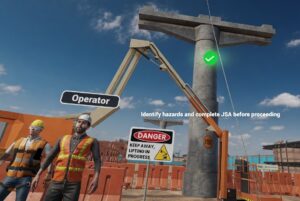
For example, a learner might inspect a work area, identify a hazard and decide whether the task can proceed. The simulation can record a missed check, explain its significance and allow another attempt.
A useful training session follows a deliberate sequence:
- Introduce the objective. Explain the task and what successful performance involves.
- Let the learner attempt it. Give them meaningful actions and decisions.
- Provide feedback. Explain which steps were missed and why they matter.
- Discuss the attempt. Give the instructor an opportunity to address misunderstandings.
- Practise again. Let the learner apply the feedback.
- Assess independently. Check performance with prompts removed.
A guided attempt teaches the process. An independent attempt helps reveal what the learner can do without assistance.
Where can VR fit in industrial safety training?
The following examples illustrate possible training designs. They are not reports of measured client outcomes.
Construction: recognising hazards before starting work
A construction scenario could place a learner in a simulated work area and ask them to inspect it before beginning a task.
The exercise might require them to identify unsafe access, recognise an unprotected edge or decide that a condition needs to be reported.
The instructor could review:
- Which hazards the learner identified.
- Which hazards they missed.
- Whether they chose an appropriate action.
- Whether they can explain their decision.
The next assessment should use a changed scenario so that passing requires recognition rather than memorising where the hazards appeared.
Practical instruction and supervised assessment remain important for physical tasks such as using equipment or inspecting a real work area.
Manufacturing: rehearsing a company’s procedure
A manufacturing simulation could help workers rehearse an approved machine-isolation procedure.
The training would need to reflect the relevant equipment, responsibilities and checks. Your subject experts should approve the procedure represented in the simulation.
The assessment could examine whether the learner follows the required sequence, misses critical steps or repeatedly needs assistance.
This gives the trainer specific points to review before supervised practice on the actual equipment.
The simulation’s usefulness depends on accuracy. A polished module that teaches a different procedure from the one used at your plant can create confusion.
Chemical plants: practising decisions during an abnormal situation
A chemical-plant scenario could present a simulated alarm or abnormal condition and ask the learner to respond according to the site’s approved procedure.
The objective might be recognising the situation, communicating the relevant information and selecting the appropriate next action for their role.
The assessment could examine:
- Whether the learner recognised the relevant cues.
- Whether their decisions followed the approved procedure.
- Whether they communicated with the correct role.
- Which decisions required instructor intervention.
The scenario must reflect the process, hazards and responsibilities being taught. A generic emergency scene may be useful for an introduction, but it needs careful review before being used to assess a site-specific response.
Is VR training just a compliance activity?
It can become one if the programme measures only attendance and completion.
A record showing that someone finished a module confirms participation. It tells you much less about whether they can recognise a hazard, explain a decision or perform a procedure independently.
Compliance records and useful learning can support each other. The assessment needs to show more than a completed session.
For example, a trainer should be able to distinguish between a learner who completed the exercise with repeated hints and one who performed the critical steps independently.
Both may reach the end. Their next training needs are different.
How can you tell whether VR training works at your site?
Agree on the measures before the pilot starts.
| Question | What to measure |
|---|---|
| What could workers do before training? | A baseline knowledge or practical assessment |
| What did they learn? | Performance on a comparable assessment after training |
| Can they perform independently? | Critical errors and assistance required without prompts |
| Do they remember it? | A follow-up assessment after an agreed interval |
| Does it transfer to work? | Appropriate supervised observation or practical assessment |
| Can the programme operate reliably? | Actual session time, trainer workload and completed sessions |
Where feasible, compare the pilot with your current training approach using similar learners, objectives and assessments.
If the VR group receives substantially more practice or instructor attention, account for that when interpreting the results.
For a pilot, measures such as missed critical steps and independent performance provide a more direct view of learning than excitement ratings alone.
Incident trends can also be monitored over time. However, a change in incidents may reflect several factors, including exposure, equipment, supervision and reporting practices. Avoid attributing the whole change to VR without supporting evidence.
When might VR add little value?
VR may be a poor fit when a simpler method meets the learning objective equally well.
It can also underperform when:
- Learners follow prompts without making meaningful decisions.
- The procedure is inaccurate or outdated.
- The assessment rewards completion while overlooking critical mistakes.
- Controls or language make the exercise difficult to understand.
- There is no opportunity to review errors and practise again.
- The task depends on physical feedback the equipment cannot adequately represent.
Operating a virtual control with a handheld controller does not necessarily demonstrate the ability to handle the real equipment.
Plan the learning programme around what each method can teach: explanation, simulation, equipment practice and supervised workplace assessment.
Does effective VR training need to be custom-built?
It needs to match the learning objective.
An existing module may suit general hazard-recognition training. A task involving your equipment, permit process or operating sequence may require adaptation or a new simulation.
Before commissioning a complete virtual factory, identify the details that affect the learner’s decisions. Those details deserve attention first.
You can read more about the options in our custom VR training cost guide.
Start with one task and a measurable objective
Choose a procedure where employees need more practice or where realistic rehearsal is difficult to arrange.
Define what the learner must recognise and do. Have your subject experts review the scenario, then evaluate learning and practical performance with a small group before expanding.
At HapzXR, we can discuss adapting training around your procedures and setting up a VR training lab with modules, headsets, reporting and preparation for your trainers.
Tell us which task your workers need to practise and how you assess it today. We’ll discuss whether VR is a suitable approach and what a useful pilot should demonstrate.