


A driver can spend years on the road and never experience a tyre blowout at highway speed.
A mining operator may never feel a loaded haul truck begin to lose traction on a difficult descent.
A forklift operator can complete every required training module without ever having a pedestrian suddenly step into the vehicle’s path.
That sounds like good news.
From a training perspective, it creates a difficult problem.
These situations are rare. They are also the situations where a few seconds and one wrong decision can have serious consequences.
So how do you prepare someone for an event you hope never happens?
You cannot deliberately create a near-collision in a warehouse. You cannot keep putting a truck into dangerous conditions so a driver can practice recovering from them. You cannot place workers around heavy equipment just to test whether a new operator notices them.
We need people to experience these situations.
But we don’t want the situations to happen.
This is where simulation becomes valuable.
Most training prepares people for the normal day
Traditional driver and equipment training does many things well.
Here is the machine.
Here are the controls.
Here are the safety procedures.
Here is how you inspect it.
Here is how you operate it correctly.
Now demonstrate that you understand.
But serious incidents don’t always happen during the normal version of the job.
They happen when something changes.
A pedestrian appears from behind an obstruction.
A vehicle enters a blind spot.
Visibility suddenly drops.
The road becomes slippery.
A load shifts.
An operator misjudges a slope.
A driver looks away at exactly the wrong moment.
Another machine behaves differently from what the operator expected.
At that point, training is no longer just about remembering a rule.
It is about recognizing what is happening and making the right decision quickly.
And those are often the hardest situations to practice safely in the real world.
The real machine is often the worst place to make the first mistake
Mistakes are part of learning.
We try something.
We get it wrong.
We understand why.
Then we try again.
That process works beautifully when the consequence of a mistake is a wrong answer or another attempt.
It becomes much more complicated when the learner is sitting inside a truck, forklift, excavator or other heavy machine.
Brake too late.
Turn too sharply.
Miss something in the blind spot.
Approach a slope incorrectly.
React badly when another vehicle crosses the path.
With real equipment, the mistake may involve an expensive machine, another vehicle or, most importantly, another person.
The problem isn’t that people make mistakes while learning.
The problem is where we ask them to make those mistakes.
What if some of those mistakes happened earlier?
Imagine moving part of that learning curve to a simulator.
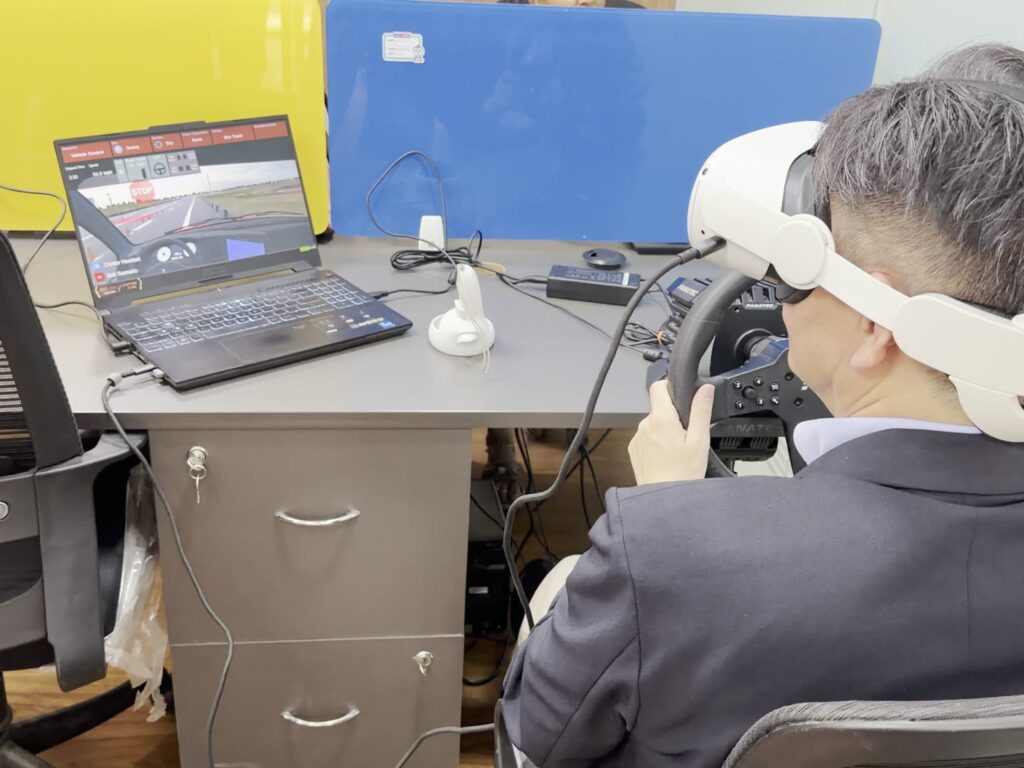
The operator enters a virtual environment that represents the vehicle, equipment or workplace they need to understand.
They start driving.
Something goes wrong.
They react too late.
The simulation stops.
Nobody is hurt.
Nothing is damaged.
Reset.
Try again.
This time the operator recognizes the hazard earlier but makes the wrong decision.
Reset.
Again.
Now change the conditions.
Reduce visibility.
Add traffic.
Introduce a pedestrian.
Change the weather.
Put another piece of equipment in the blind spot.
Create the situation that would be difficult, expensive or irresponsible to deliberately recreate with real equipment.
Then let the trainee practice it until their response improves.
That ability to make a consequential mistake without the real-world consequence is one of the most useful things simulation can offer.
Train the situations you cannot afford to recreate
The machine may change from one industry to another, but the training problem is often remarkably similar.
Commercial fleets and trucking
Drivers can practice hazard recognition, emergency situations, blind spots, reversing, poor weather, distraction and difficult road conditions without exposing a real vehicle to unnecessary risk.
Logistics and last-mile delivery
Drivers regularly work around pedestrians, cyclists, loading areas, narrow streets and tight reversing spaces. Simulation can reproduce these environments repeatedly without needing to create the hazards physically.
Mining
Haul trucks and other mining equipment operate in environments where visibility, terrain, vehicle interaction and equipment size can make mistakes particularly serious.
Simulation can expose operators to unusual or high-risk scenarios before they encounter similar conditions in an operating mine.
Mining safety researchers have explored virtual environments for applications including haul-truck inspection and mine-safety training, demonstrating how simulation can complement conventional training when real-world practice is difficult or hazardous.
Construction and heavy equipment
Excavators, loaders and other machines frequently operate around workers and other equipment.
A simulator can allow operators to practice procedures, spatial awareness, hazard recognition and difficult scenarios without using an active worksite as the classroom.
Warehousing and manufacturing
Forklifts and material-handling vehicles often share relatively small spaces with people.
Instead of putting a real pedestrian into a dangerous training scenario, the pedestrian can exist inside the simulation.
Emergency and specialist vehicles
Some drivers need to make decisions under conditions that ordinary road training cannot easily reproduce on demand.
Simulation provides a way to repeat those situations and review the driver’s response afterwards.
Different industries.
Different vehicles.
The same question:
How do you give someone experience without exposing them to the consequences of gaining it?
Aviation solved this problem a long time ago
Nobody is surprised when a pilot trains in a simulator.
We expect it.
A pilot can practice an engine failure without destroying an engine.
They can experience severe weather without waiting for a storm.
They can make the wrong decision during an emergency and discover what happens next without putting passengers at risk.
The simulator does not eliminate the need to fly a real aircraft.
That is not the point.
It allows certain experiences to happen before they need to happen for real.
The same principle can apply to drivers and equipment operators.
Simulation is not a replacement for every form of real-world training, nor should it be.
A driver still needs real driving experience.
An equipment operator still needs supervised experience with the actual machine.
But the first time they sit inside that machine does not have to be the first time they have seen its controls.
And the first real emergency does not have to be the first time they have thought through how to respond.
Training can become measurable, not just repeatable
There is another difference between watching a training video and actually performing inside a simulation.
The simulation can record what the trainee does.
How fast were they traveling?
When did they begin braking?
How long did they take to react to a hazard?
Did they maintain the required distance?
Did they check the required mirrors or blind spots?
Did they follow the correct procedure?
Did they make the same mistake again?
That changes the conversation from:
“Did this employee complete the training?”
to:
“How did this employee perform during the training?”
Those are very different questions.
One produces a completion record.
The other can reveal where someone still needs practice.
If an operator repeatedly struggles with reversing, give them more reversing scenarios.
If another trainee reacts slowly to pedestrians, practice pedestrian hazards.
If a driver performs well under normal conditions but struggles when visibility drops, train that condition.
Instead of giving every employee exactly the same experience, simulation can help training focus on the areas where practice is actually needed.
The simulator should look like the job, not like a technology demo
This part matters.
A mining company does not need a generic driving game.
A logistics company does not need a beautiful virtual world that has nothing to do with its delivery environment.
And a construction company does not need VR simply because VR looks impressive in a presentation.
Useful simulation starts with the job.
What vehicle does the operator use?
What controls matter?
What does the actual environment look like?
What mistakes are trainers seeing?
What near misses concern the safety team?
Which situations are difficult to reproduce?
What behavior does the company want to measure?
The answers should shape the simulation.
That might mean recreating a specific vehicle.
It might mean integrating a steering wheel, pedals, joysticks or other physical controls.
It might mean reproducing a warehouse, road, mine or worksite.
It might mean creating traffic, pedestrians, weather, equipment failures or other hazards.
It might also mean connecting training results to a dashboard so instructors can see where operators are struggling.
The goal is not to make the most impressive VR experience.
The goal is to create useful practice.
Not every training problem needs VR
This may be the most important question when considering simulation:
What are we trying to let this person practice that they cannot practice safely, repeatedly or economically today?
If a five-minute video can teach it properly, use the video.
If a classroom explanation is enough, use the classroom.
If the task can be practiced safely and inexpensively with real equipment, real-world practice may be the better answer.
VR becomes interesting when something important is missing.
Perhaps the equipment is expensive or unavailable for training.
Perhaps taking it out of production costs money.
Perhaps the environment is dangerous.
Perhaps a particular emergency is too rare to practice consistently.
Perhaps you need every trainee to experience exactly the same scenario.
Or perhaps the mistake you need them to learn from is a mistake you cannot safely allow them to make for real.
That is where simulation earns its place.
The point isn’t VR
When people see a modern simulator, the technology naturally gets the attention.
The headset.
The steering wheel.
The pedals.
The physical controls.
The virtual vehicle.
The graphics.
But those are not the most interesting part.
The interesting part is where the mistakes happen.
We can move some of them forward.
Before the real truck.
Before the real forklift.
Before the real excavator.
Before the active mine or construction site.
Before another worker is standing beside the machine.
Let the trainee brake too late.
Let them miss the hazard.
Let them choose the wrong response.
Then reset.
Explain what happened.
And let them try again.
Because when mistakes are part of learning, the safest place to make the first one is somewhere the consequences aren’t real.
What is the scenario you wish your operators could practice — but can’t safely recreate?
That is usually a better place to start than asking whether your company needs VR.
At HapzXR, we design custom VR and simulation-based training around real vehicles, equipment, work environments and operating scenarios.
If there is a driver or operator scenario your team finds difficult, dangerous or expensive to reproduce in real-world training, show us the scenario.
We’ll help you explore whether simulation makes sense for it.
[Talk to HapzXR about your training scenario →Contact]