Work at height, confined space, LOTO and induction under one roof. The hard parts are the room, the arithmetic and the records, not the headsets.
A few weeks ago an adhesives manufacturer asked us a question we had not been asked in quite that shape before.
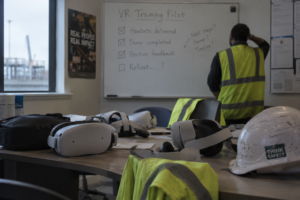
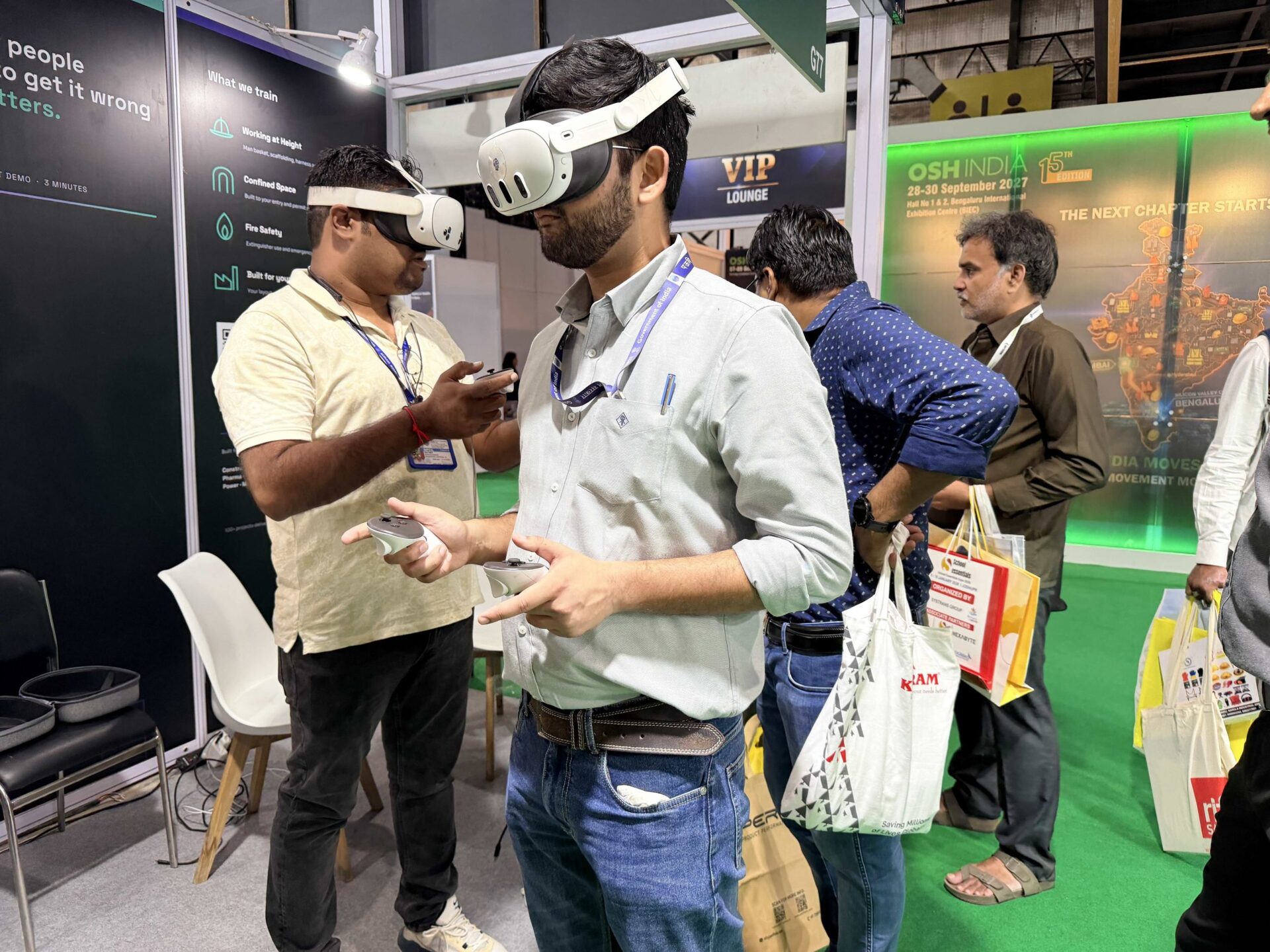
They did not ask for a VR module. They asked us to help them set up a lab. A room in their plant where workers go through work at height, confined space entry, lockout tagout and site induction, in a headset, as a standing part of how the plant trains people.
That is a different purchase. A module is a piece of content. A lab is a facility with throughput, an owner, a running cost and an audit trail. Most of what gets written about VR safety training is about the content, because content is the fun part. Almost nobody writes about the rest of it.
So here is the rest of it.
Start with the arithmetic, not the headsets
The first question everyone asks is how many headsets they need. It is the wrong first question, and it has no answer until you do a piece of arithmetic that takes about five minutes.
Work out how many people have to go through each module in a year. Contract workers usually dominate this number and usually get forgotten in the first estimate. A plant that employs 200 people might induct 600 bodies a year once you count contractors, and contractors are exactly the population most likely to be hurt.
Then work out how long one person occupies one station. This is not the length of the module. A twenty minute module is roughly a thirty minute slot once you include the briefing, fitting the headset, the two minutes a first time user spends learning to point, the debrief, and wiping the facial interface for the next person.
Now divide. Six stations at thirty minutes each is twelve people an hour. Six hundred inductions is fifty hours, which is about seven working days spread across the year. That is the real answer, and it usually surprises people in a good way.
Do that sum before anyone quotes you for hardware. If a vendor proposes a headset count before asking how many workers you train a year, they are guessing, and you are paying for the guess.
The room will cause you more trouble than the software
This is the part that gets skipped and then becomes a six week delay.
Space per station. A worker reaching overhead for a lifeline anchor needs more room than a seated office demo. Two metres by two metres clear is the floor, three by three is comfortable, and comfortable matters because a cramped boundary makes people move tentatively, which is the opposite of what you want when you are training a physical task.
Light and surfaces. Modern headsets track by looking at the room. They do badly with direct sunlight, with large mirrors, with glossy painted walls and with glass partitions. A plant training room with a big window facing west will work beautifully in the morning and fail at four in the afternoon. Blinds are cheaper than a support ticket.
No cables on the floor. Someone in a headset cannot see their feet. This sounds obvious and it is the single most common near miss in VR training rooms.
A screen on the wall. Cast the live view so the trainer and the waiting group can see what the person in the headset is doing. This is not a nice to have. It is most of the teaching value, because the debrief happens in the room, not in the headset, and the group learns from watching someone else get it wrong.
Charging and storage. A cabinet or cart with enough sockets, near the room, not in another building.
Hygiene. Wipeable facial interfaces and a box of disposable covers. In a plant where people come off shift sweating in summer, this decides whether the lab gets used in June.
Network and IT, early
Bring your IT team in before you order anything.
Standalone headsets are unmanaged devices that want to join a network. Your IT and security people have a view about that, and it is usually a reasonable view, and it always takes longer than anyone plans for. Ask three questions at the start: which device management platform will these enrol in, what network access does the application actually need while running, and who owns the vendor account.
If that conversation starts after the hardware has arrived at the gate, you have just added weeks to a project that was supposed to be showing results.
A dedicated access point for the training room is worth the small cost. Plant Wi-Fi is usually designed for handhelds and sensors, not for a room where six devices want to sync session data at the same moment.
Which modules, and in what order
The instinct is to build all four at once, because all four are needed. Do not.
Build induction first. This is counterintuitive, because induction is the least dramatic of the four and the one with the lowest consequence if it goes wrong. Build it first anyway, for three reasons. It carries the highest volume, so it justifies the lab on its own. It gets every single worker into a headset once, which means that when you later put them into a confined space scenario the novelty is already gone and they can concentrate on the hazard instead of the controls. And it is the module most likely to be running smoothly by the time anyone senior comes to look.
Then take the highest consequence module you have. In a chemical plant that is usually confined space entry or lockout tagout, depending on your own incident history and on what your last audit flagged. Your incident log should pick this, not a vendor’s catalogue.
Work at height tends to come third, not because it matters less but because it is the one your workers are most likely to have had some real practical training in already.
The thing VR can train that a live drill cannot
Worth saying plainly, because it is the actual argument for the medium.
There is a well documented pattern in confined space incidents where the people who die are the ones who went in to help. Someone goes down, a colleague follows without a rescue plan or breathing apparatus, and the incident doubles. That pattern is the single most important thing a confined space entrant needs to internalise.
And you cannot drill it. You cannot run a physical exercise in which the rescue goes wrong and a second person is overcome, because the whole point of a physical exercise is that nobody is hurt. The scenario that matters most is the one your safety systems exist to prevent you from ever rehearsing.
In a headset you can run it. You can let someone make the instinctive decision, let it go badly, and then talk about it in the room afterwards with everyone who watched it on the screen. That is a genuinely new capability, not a more expensive version of a video.
One caution on this. The confined space statistics that circulate on LinkedIn, including the widely quoted figure about the proportion of fatalities who are would be rescuers, trace back to a small NIOSH case series from decades ago and get requoted without that context. The pattern is real and well evidenced. The precise percentages are not national rates, and if you put them in a presentation an experienced safety manager may well call it.
Where this sits legally in India
This is the part US focused VR vendors do not write about, and it is the part your inspector cares about.
Section 7A(2)(c) of the Factories Act, 1948 places a duty on the occupier to provide “such information, instruction, training and supervision as are necessary” to ensure the health and safety of workers at work. Section 7A(3) requires a written statement of general policy on health and safety, kept revised and communicated to workers. Training is not optional and neither is evidencing it.
Rule 13(4) of the MSIHC Rules, 1989 requires the occupier to ensure a mock drill of the on-site emergency plan is conducted every six months, and Rule 13(5) requires a detailed report of that drill. Rule 4(2)(b)(ii) requires providing persons working on site with the information, training and equipment necessary for their safety. For the off-site plan, Rule 14(4) puts a rehearsal at least once a calendar year on the concerned authority.
Now the honest part, and please read this before anyone sells you something on the back of it.
VR does not discharge your Rule 13 mock drill obligation. A mock drill under that rule is a physical exercise involving real people moving in the real plant. A headset does not satisfy it and any vendor who implies otherwise is doing you harm. What VR does is let you rehearse the decision making far more often than twice a year, with the people who will be making those decisions, so that the statutory drill is not the first time anyone has thought it through. It also produces a record of who practised what and where they went wrong, which is a useful thing to have in the file alongside the drill report rather than instead of it.
That distinction is worth insisting on with any supplier. It tells you whether they understand the regulation or have just read the summary.
What the lab should produce on paper
A training lab that produces no records is a games room with a safety theme.
Decide at the start what each session writes down and where it goes. At minimum: who trained, on what, when, how long they took, whether they passed, and which specific steps they got wrong. That last one is the valuable one and the one most often left out, because step level failure data tells your EHS team where the real misunderstandings are across the whole workforce, not just who scored what.
Then decide whether those records need to land in your existing training system or HR system. If they do, put that integration in the original scope. Phase two integrations have a way of never being funded, and a training record that lives only in a vendor dashboard tends to be re-keyed into a spreadsheet by someone in EHS for about three weeks before everyone quietly stops.
Running cost, not just build cost
Four things cost money every year after the lab opens, and the first budget usually includes none of them.
Content updates, because your procedures will change and a module teaching last year’s permit flow is worse than no module. Hardware refresh and a spares ratio, because headsets get dropped. Consumables, which is the cheap and boring one. And a named person’s time, which is the expensive one everybody forgets.
That last point is worth dwelling on. Every VR training programme I have seen fail has failed in the same way. It had an enthusiastic champion, no owner, no budget line and no slot in the annual training calendar. The champion got promoted or moved plant, and the headsets went into a cupboard. Before the lab opens, write down who owns it next year, which budget it sits in, and which existing mandatory training it supplements. If you cannot answer all three, you do not have a programme yet.
What we would do in the first ninety days
Roughly this. Sit with the EHS team and the incident log and pick the module order from what has actually hurt people or failed an audit. Do the throughput arithmetic and let it set the headset count. Walk the proposed room with a tape measure and a light meter. Get IT in the room in week one. Build induction, run it with a real cohort of contractors rather than a cohort of managers, and watch where they get stuck. Then build the high consequence module with everything you learned from the first one.
Nothing in that list is about graphics.
What we are and are not
We build industrial VR training. Work at height, confined space, lockout tagout, fire and evacuation, induction, plant and equipment. That is our actual portfolio and it is where our proof is.
We are not a safety consultancy. We do not write your permit system, we do not sign off your on-site emergency plan, and we are not the people to tell you what your legal obligations are. Your EHS lead and your inspector own that. What we do is take a procedure your team already owns, and turn it into something a worker can practise until it is automatic.
If you are scoping a VR safety lab and you want a blunt conversation about what it will cost you to run in year three, rather than what it costs to build in month one, we are happy to have that conversation whether or not you build it with us.
Sources
- The Factories Act, 1948, Section 7A, General duties of the occupier. https://www.advocatekhoj.com/library/bareacts/factories/7a.php
- The Manufacture, Storage and Import of Hazardous Chemicals Rules, 1989, Rules 4, 13 and 14. https://ifbgoa.goa.gov.in/sites/default/files/Manufacture_Storage&Import_of_Hazardous_Chemical_Rules%201989.pdf