The surgical VR industry has spent a decade and hundreds of millions of dollars on the hard part. The part trainees actually struggle with first is cheaper to build, and almost nobody is building it.
Here is a situation every orthopaedic trainee recognises.
It’s a Saturday. There’s a fractured neck of femur on the trauma list, the patient is 84 and needs a hemiarthroplasty, and you’re the registrar. You have seen the Hardinge approach done maybe forty times. You have assisted on plenty. You have read Hoppenfeld, you could draw the layers on a napkin, and you passed the exam that asked you about the superior gluteal nerve.
None of that is the same as standing there with the knife, on your own, for the first time.
What gets you in that moment is not the technical skill. It’s orientation. You’re in tissue that looks nothing like the diagram, the patient is bigger than the textbook, the light is wrong, and the question running underneath everything is a simple one.
Where am I?
That question is the thing. And it’s the thing that current surgical VR, for all its funding and all its polish, mostly isn’t built to answer.
What the industry decided to sell
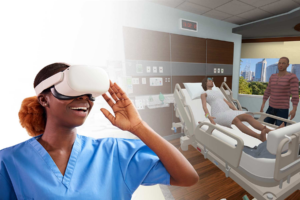
Look at what the major platforms actually do. Osso VR, PrecisionOS, FundamentalVR, ImmersiveTouch, VirtaMed. Between them they’ve raised a great deal of money and built genuinely impressive technology. Osso alone raised $66 million back in 2022.
Most of them converged on the same two ideas.
The first is a catalogue. You license a library of procedures, usually for something between $5,000 and $20,000 per user per year, and your trainees work through the modules that exist. The second is haptics. Several of the leading platforms have poured enormous engineering effort into force feedback, because they’re simulating the moment of cutting, drilling, reaming, and that moment genuinely needs to feel like something. VirtaMed’s hardware units run somewhere between $100,000 and $300,000.
That’s a reasonable business. It’s also a specific bet: that the hard problem in surgical training is reproducing the feel of tissue.
For some procedures, that’s right. For learning an approach, I think it’s the wrong end of the problem.
Approach is a spatial problem, not a tactile one
Think about what you’re actually learning when you learn an approach.
You’re learning which plane to develop and where it is relative to things you must not damage. You’re learning what the field looks like at each layer, and what it looks like when it’s gone wrong. You’re learning how the anatomy shifts when the patient is obese, or when the fracture has displaced things, or when there’s scar tissue from a previous operation. You’re learning to recognise where you are when the landmark you were taught to look for isn’t obvious.
Almost none of that is about force feedback.
You don’t need a haptic rig to learn that the superior gluteal nerve sits roughly five centimetres above the tip of the greater trochanter and that this is why the split goes where it goes. You need to see it, from your own eyeline, with the layers peeled back in the order you’ll meet them, as many times as it takes to stop thinking about it.
That’s a spatial and visual learning problem. Headsets are extremely good at spatial and visual learning problems, and they are good at it now, on hardware that costs a few hundred pounds, without a haptic arm bolted to a desk.
Which is what makes the gap strange. The cheapest thing to build is the thing least well served.
The evidence, honestly
I want to be careful here, because this is an area where people overclaim constantly and surgeons can smell it.
There’s a 2025 systematic review and meta-analysis in JMIR covering 23 randomised controlled trials and 1,091 participants in orthopaedic education. VR training outperformed conventional teaching across the board. The effect on clinical operation scores was large (SMD 1.44). The effect on knowledge was large (SMD 1.08).
The biggest effect of all was on surgical design and planning scores: SMD 1.75.
That last number is the interesting one for this argument, because planning and approach rehearsal are close cousins. The thing VR did best in the pooled evidence is the thing the market is least focused on selling.
Now the caveats, which matter.
The authors flag substantial heterogeneity between VR platforms, and they’re right to. “VR works” is not a transferable claim. It’s evidence that some VR, built some way, for some tasks, worked in some trials. It says nothing about whether any particular product works, including one we would build.
These studies also measure simulated and early-stage performance. They do not show improved patient outcomes, and anyone telling you VR training improves patient outcomes is going considerably further than the evidence does. I’m not going to do that here.
What the evidence supports is narrower and still worth something: structured, repeatable VR rehearsal improves how trainees perform on the skill being trained, and it does so most strongly for planning-type tasks.
Why the UK case is different
The big platforms are American, and their catalogues reflect that. They’re built around procedures with volume, sponsorship, and a commercial reason to exist, which in practice means a lot of arthroplasty, a lot of sports medicine, and a lot of whatever an implant manufacturer wanted its customers trained on.
That last point is worth saying out loud, because it explains the shape of the market. A significant share of surgical VR gets paid for by medical device and implant companies training surgeons on their own products. It’s a legitimate model and it has funded some good work. But it means the catalogue follows the implant, not the curriculum.
A UK trainee’s actual problem doesn’t always map onto that. The Hardinge approach for a hemiarthroplasty on a Saturday night is high volume, low glamour, and commercially uninteresting to an implant vendor. It is also one of the first real operations a lot of trainees do with their hands rather than their eyes.
There’s a broader version of this. UK surgical training has its own curriculum, its own assessment structures, and its own pressures on operative exposure that trainees and trainers talk about constantly. None of that is content the US platforms are building for, because it isn’t their market.
What we think should exist
Something narrow. Deliberately narrow.
A rehearsal tool for a specific approach, where a trainee can go through the layers in order, from the operating surgeon’s eyeline, as many times as they want. With the structures at risk visible and labelled when you want them and hidden when you want to test yourself. With a handful of anatomical variations rather than one idealised body, because the idealised body is not the one on the table. With the wrong plane available as a thing you can actually do, and see the consequence of, which is something no cadaver course lets you repeat and no textbook can show you.
Not a replacement for cadaveric work. Cadaver courses do things a headset will never do, and anyone who tells you otherwise is selling something. But cadaver courses happen a few times a year, cost real money, and you get one go at each dissection.
The point of the headset is repetition. Fifteen minutes on a Tuesday, then again on Thursday, then again the night before the list. That’s the thing that’s currently impossible, and it’s the thing that most resembles how people actually get good at anything.
What we’re not claiming
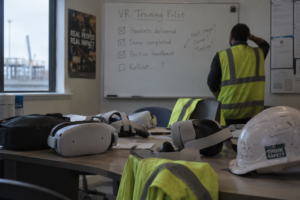
We build industrial VR training. Construction, infrastructure, heavy equipment, work at height, fire and evacuation. That’s our portfolio and that’s where our proof is. We have not built a surgical module, and I’m not going to dress this post up as though we have.
So take this as an argument, not a credential.
What I think transfers is the engineering. A procedural training framework that handles sequencing, assessment, branching on error, multi-user sessions and content that can be updated as a procedure changes is the same underlying problem whether the procedure is isolating a switchgear panel or developing a plane between gluteus medius and minimus. The fidelity bar is different. The anatomy work is specialist and would need real clinical authorship, not a developer with an atlas. But the framework is the framework.
What doesn’t transfer is clinical authority. We can’t write this content. A surgeon has to, and a surgeon has to be wrong about it in front of us a few times before it’s any good.
So that’s the actual reason this post exists. We’re trying to work out whether the gap we think we see is real, and the only people who can tell us are trainees who have stood there on a Saturday and trainers who have watched them do it.
If you’re one of them, I’d like to hear you tell me I’m wrong.
Sources
- Using Virtual Reality to Enhance Surgical Skills and Engagement in Orthopedic Education: Systematic Review and Meta-Analysis. JMIR, 2025. https://www.jmir.org/2025/1/e70266
- Comparative overview of surgical VR platform pricing, payers and haptics. https://www.reality-atlas.com/blog/best-vr-platforms-surgical-training
- Osso VR Series C funding. Fierce Healthcare. https://www.fiercehealthcare.com/health-tech/osso-vr-grabs-66m-scale-virtual-reality-surgical-training-tech