The global healthcare industry is facing a challenge that extends far beyond staffing numbers.
Hospitals, nursing schools, and healthcare organizations are struggling to train enough nurses while ensuring every graduate is prepared for the realities of patient care.
The nursing shortage has become one of the most discussed healthcare workforce issues worldwide. Yet an equally important challenge often receives less attention: inconsistent clinical training experiences.
Not every nursing student encounters the same situations during their education. Some gain exposure to emergency scenarios, critical care situations, and complex patient interactions. Others may graduate without ever facing these challenges in a realistic environment.
As healthcare systems look for ways to improve training quality while addressing workforce shortages, many are exploring a combination of Artificial Intelligence (AI) and Virtual Reality (VR) to bridge the gap.
The Growing Nursing Shortage Problem
Healthcare systems around the world are experiencing increased demand for qualified nursing professionals.
Several factors are contributing to this challenge:
- Aging populations requiring more healthcare services
- Increased patient volumes
- Nurse burnout and workforce attrition
- Retirement of experienced healthcare professionals
- Growing demand for specialized care
As hospitals work to onboard new nurses more quickly, training departments face mounting pressure to ensure every nurse is clinically prepared from day one.
The challenge is no longer simply recruiting nurses.
The challenge is preparing them effectively.
Why Traditional Nursing Training Isn’t Always Enough
Nursing education has evolved significantly over the years, but several limitations still exist.
Limited Clinical Exposure
Healthcare environments are unpredictable.
One student may experience multiple emergency cases during clinical placements, while another may encounter very few.
This creates significant differences in practical experience.
Limited Simulation Availability
Many nursing schools rely on simulation labs to provide hands-on learning opportunities.
However, simulation labs require:
- Specialized equipment
- Dedicated facilities
- Instructors
- Scheduling resources
As student numbers increase, access to simulation experiences can become limited.
Fixed Learning Scenarios
Traditional simulation exercises often follow predefined scripts.
Students know there is a planned outcome.
Real patients rarely follow predictable scripts.
Healthcare professionals must constantly adapt to changing conditions and unexpected situations.
The Hidden Cost of Inconsistent Clinical Training
When nurses enter the workforce with varying levels of practical experience, healthcare organizations often face challenges such as:
- Longer onboarding periods
- Increased supervision requirements
- Lower confidence among new nurses
- Higher training costs
- Greater pressure on experienced staff
Most importantly, healthcare organizations want every nurse to feel prepared when facing real patient situations.
Achieving that consistency remains difficult with traditional training methods alone.
How AI-Powered Virtual Patients Are Changing Healthcare Training
This is where AI and VR can work together to create a new generation of clinical training experiences.
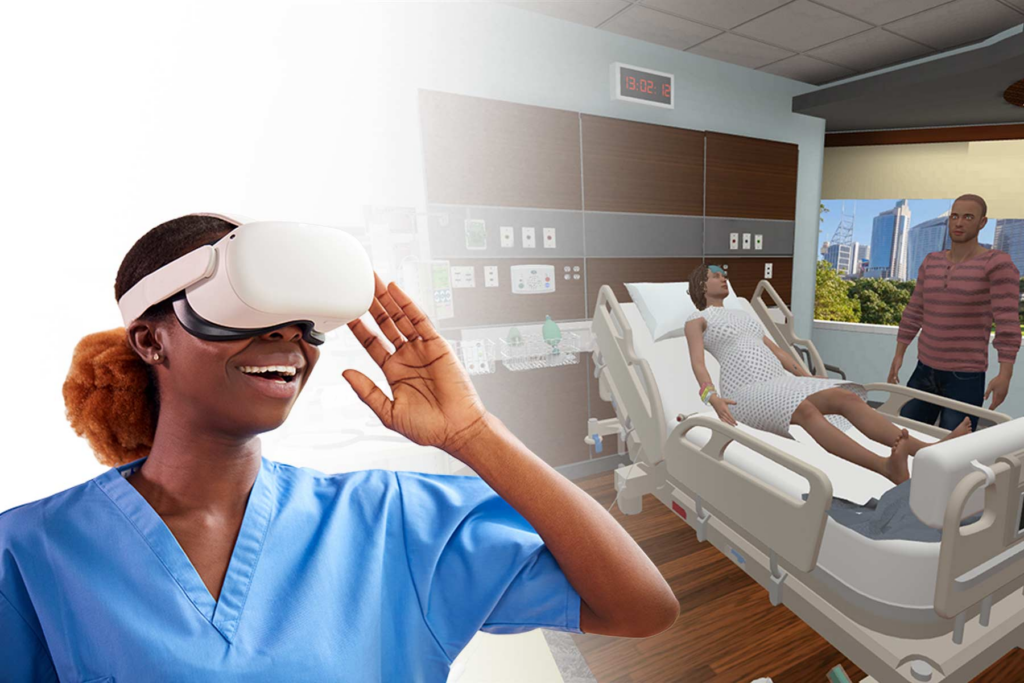
Imagine a nursing student entering a virtual emergency room using a VR headset.
A patient arrives showing signs of respiratory distress.
The student must:
- Assess symptoms
- Monitor vital signs
- Communicate with the patient
- Make treatment decisions
- Escalate care when necessary
Unlike traditional simulations, the patient is powered by AI.
The virtual patient can:
- Answer questions naturally
- Show realistic emotional responses
- Display changing symptoms
- React differently based on clinical decisions
- Simulate worsening or improving conditions
Every training session becomes unique.
Every decision has consequences.
Every student gains valuable experience in a safe environment.
Benefits of AI-Powered VR Nursing Training
Consistent Learning Experiences
Every student can be exposed to critical scenarios regardless of location, instructor availability, or clinical placement opportunities.
Safe Environment for Mistakes
Students can learn through trial and error without putting patients at risk.
Mistakes become learning opportunities.
Unlimited Practice Opportunities
Unlike traditional simulation labs, virtual training environments can be accessed repeatedly, allowing learners to practice until they build confidence.
Improved Clinical Decision-Making
AI-driven simulations help students develop critical thinking skills rather than simply memorizing procedures.
Scalable Training
Healthcare organizations can train larger numbers of students without requiring additional physical simulation equipment.
Real-World Applications
AI-powered virtual patient simulations can support training for:
Emergency Care
Students can practice responding to:
- Cardiac arrest
- Respiratory emergencies
- Trauma cases
- Patient deterioration
Patient Communication
Virtual patients can simulate:
- Anxiety
- Frustration
- Confusion
- End-of-life discussions
Helping nurses improve communication skills before entering clinical environments.
Specialized Care Training
Organizations can create simulations focused on:
- Pediatrics
- Geriatric care
- Critical care
- Mental health
- Surgical recovery
Providing exposure to situations students may not frequently encounter during placements.
The Future of Nursing Education
AI and VR will not replace clinical placements, instructors, or hands-on patient care.
However, they can significantly enhance how future nurses prepare for real-world healthcare environments.
The most successful nursing programs will likely combine:
- Classroom education
- Clinical placements
- Traditional simulation labs
- AI-powered virtual patient training
Together, these approaches can help create more confident, capable, and practice-ready healthcare professionals.
Conclusion
The nursing shortage is one of the biggest challenges facing healthcare systems today. At the same time, ensuring consistent and effective clinical training remains equally important.
AI-powered virtual patients offer a practical way to provide realistic, repeatable, and scalable learning experiences that help bridge gaps in traditional training methods.
As healthcare organizations continue investing in workforce development, AI and VR technologies have the potential to play a significant role in preparing the next generation of nurses for the realities of patient care.
How HapzXR Can Help
At HapzXR, we develop immersive VR, AR, and AI-powered training solutions designed to improve learning outcomes across healthcare, medical education, and professional training environments.
Whether you’re exploring virtual patient simulations, nursing training platforms, or healthcare workforce development solutions, our team can help transform complex learning challenges into engaging immersive experiences.
Interested in developing AI-powered healthcare training simulations? Contact HapzXR to discuss your requirements.