HapzXR is Revolutionizing Training with AI and XR
Training is a cornerstone of professional development and skill acquisition, yet traditional methods — such as classroom lectures, slide presentations, and limited hands-on practice — often fail to fully engage learners. The emergence of Artificial Intelligence (AI) and Extended Reality (XR) promises to transform these conventional approaches, delivering training that is more personalized, immersive, and effective.
How AI and XR Enhance Training
AI: Personalization and Real-Time Feedback
- Analyze a learner’s performance — tracking speed, accuracy, and comprehension.
- Customize content to match the learner’s pace, skill level, and learning style.
- Provide instant feedback, pinpointing strengths and areas for improvement.
XR: Immersive, Hands-On Practice
- Safe experimentation: Learners can make mistakes without real-world consequences.
- Realistic scenarios: From operating heavy machinery to performing surgery, XR replicates high-stakes situations.
- Engagement: Immersive experiences captivate learners, boosting retention and motivation.
Real-World Examples
1. Healthcare: Precision Practice for Surgeons
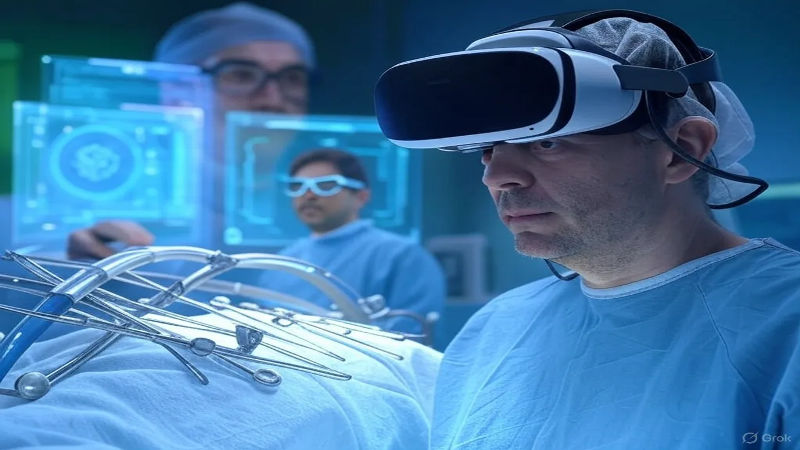
Surgeons use VR to simulate complex procedures while AI analyzes hand movements, speed, and decision-making, offering feedback on technique.
2. Manufacturing: Mastering Machinery
Workers learn to operate industrial equipment via AR overlays while AI monitors progress and suggests corrections.
3. Education: Immersive Learning Journeys
Students explore historical events or scientific phenomena in VR while AI acts as a virtual tutor.
Key Advantages
- Personalization — AI adapts training to each individual.
- Immersion — XR creates engaging, hands-on experiences that stick with learners.
- Accessibility — Virtual environments eliminate the need for physical presence.
- Engagement — AI can gamify training with rewards and challenges.
- Safety and Efficiency — Mistakes in virtual settings carry no real-world cost.
The Future of Training
As AI and XR technologies mature, their influence on training will only grow. Hyper-realistic simulations, AI-driven lifelong learning, and global collaboration in shared virtual spaces are on the horizon. The classroom of tomorrow is here — and it’s virtual, intelligent, and limitless.