


Revolutionizing Medical Education: How HapzXR Built an Immersive Human Anatomy Experience
At HapzXR, we believe that the future of learning lies in experience. That’s why when we were approached to build a next-gen anatomy learning tool for medical students, we didn’t just create another app — we built an immersive virtual journey through the human body.
Traditional anatomy education relies heavily on textbooks, 2D diagrams, cadavers, and lectures. While effective to some extent, this method has limitations — especially when it comes to spatial understanding, student engagement, and accessibility.
Our client, a progressive medical institution, wanted a solution that could overcome these barriers and bring human anatomy to life for its students.
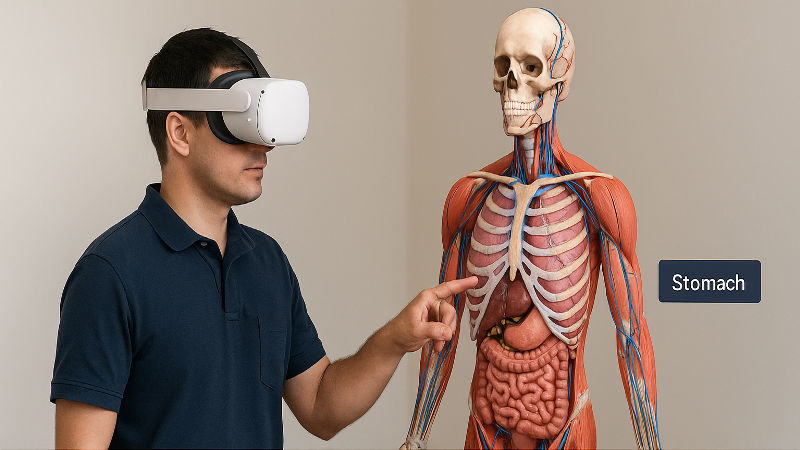
We developed an Immersive Human Anatomy VR Simulation using Unity and XR technologies. Designed for Meta Quest and PC VR headsets, the experience allows students to explore the entire human body — from the skeletal system to muscles, organs, and nervous pathways — in fully interactive 3D space.
Key features:
- 360° Exploration: Walk around, zoom in, rotate, and isolate anatomical systems in 3D.
- Guided Learning Mode: Students can follow structured modules created in collaboration with expert doctors and educators.
- Free Exploration Mode: For self-paced learning or revision.
- Interactive Labels & Voiceover: Touch an organ to get real-time information, facts, and medical context.
- Quizzes & Assessments: Built-in quizzes to test knowledge, all inside VR.
Why It Works
- Better Retention: Studies show immersive learning boosts retention by up to 75% compared to passive learning.
- Spatial Understanding: Students can understand where organs are in relation to each other — something that’s hard to grasp in a textbook.
- Accessible Anywhere: No need for cadavers or lab access — just put on a headset.
- Engaging for Digital Natives: Today’s students expect tech-rich learning. This delivers exactly that.
The Impact
Medical colleges using our VR anatomy simulation have reported:
- Increased class engagement and enthusiasm.
- Faster grasp of complex topics like cranial nerves, circulatory flow, and muscular layering.
- More confident students during practicals and exams.
What makes this project special is its scalability. Using our custom content management system, the app can be updated with new content, video lectures, and localized language support — making it perfect for institutions across the globe.
At HapzXR, we’re proud to be reshaping how complex subjects are taught. Whether it’s healthcare, defense, or manufacturing — we use the power of XR to simplify learning and supercharge training.
If you’re a medical institution looking to future-proof your curriculum, let’s talk.