


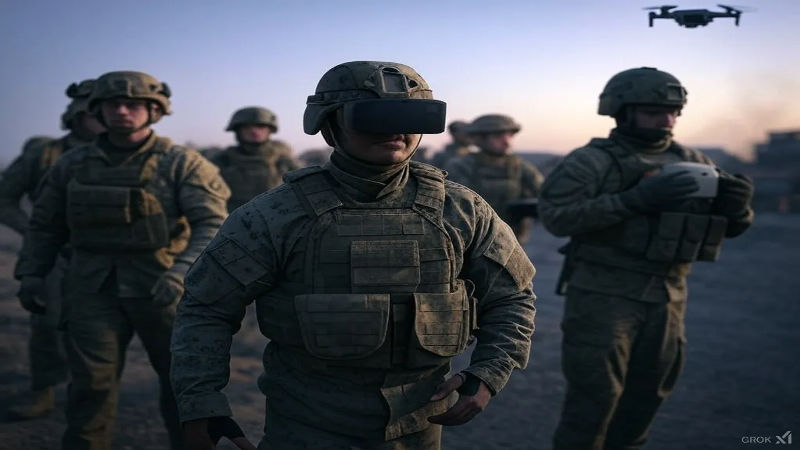
The Impact of Extended Reality (XR) in Defense
The defense industry has always been at the forefront of adopting cutting-edge technology. XR is revolutionizing military training, battlefield awareness, maintenance, and mission planning, making defense operations more efficient, immersive, and cost-effective.
1. Immersive Military Training & Simulation
- Realistic Combat Scenarios: Soldiers can engage in AI-driven combat missions, including urban warfare, counter-terrorism, and reconnaissance exercises.
- Cost Reduction: XR reduces the need for live ammunition, expensive equipment, and large-scale field exercises.
- Safe Training Environments: Dangerous scenarios can be trained in a risk-free virtual environment.
2. Enhanced Situational Awareness & Battlefield Communication
- Real-Time Enemy Tracking: AI-powered AR systems can detect and highlight enemy positions in real-time.
- Tactical Data Visualization: Commanders can see a live battlefield map overlaid onto the real-world environment.
- Improved Night Vision & Target Acquisition: Advanced AR visors assist soldiers with enhanced targeting.
3. Maintenance, Repair, and Equipment Handling
- Hands-Free Instructions: Technicians can receive real-time AR overlays showing step-by-step repair instructions.
- Remote Expert Assistance: Engineers can guide soldiers on the battlefield through AR glasses.
- Error Reduction: Interactive AR manuals help minimize human errors.
4. Mission Planning & Strategic Simulations
- Detailed 3D Maps: Commanders can interact with holographic terrain models.
- Simulated War Games: AI-driven XR simulations allow strategists to test different combat strategies.
- Collaborative Decision Making: Teams can work together in a shared virtual space.
5. Psychological & Rehabilitation Support
- Exposure Therapy: Controlled VR simulations help veterans gradually re-experience traumatic events to reduce PTSD symptoms.
- Cognitive & Emotional Resilience Training: Mindfulness and stress-reduction techniques integrated into VR programs.
- Physical Rehabilitation: XR-based rehabilitation programs assist injured soldiers in regaining motor functions.
Future Prospects
- AI-Driven XR: Smarter simulations and real-time analytics.
- 5G-Powered AR & VR: Real-time XR experiences with lower latency in battlefield scenarios.
- Haptic & Brain-Computer Interfaces: Advanced haptic feedback suits for deeper immersion.
The integration of XR technology in defense is revolutionizing how modern militaries train, strategize, and execute missions. As technology advances, XR will become an even more integral part of military operations.